The correct tuning settings for an XPAG depend on your engine number, not your model. MG changed tappet clearances, points gaps, spark plugs and cylinder-head castings partway through TD production, so generic advice is often wrong. Read your engine number off the block first, then match the figures in this article, then confirm everything against the official workshop manual before any spanner turns.
Read your engine number first
Every figure below is keyed to the XPAG/TD2 engine-number series used by MG. Before adjusting a tappet, gapping a point or fitting a plug, find and record the engine number stamped on the block. The chassis and engine number identification guide explains where the number is located on TB, TC, TD and TF cars and how to read it correctly.
Get the number wrong and you will fit the wrong plugs, set the wrong gap, or use the wrong tappet clearance, none of which are catastrophic on their own, but together they explain a large share of "rough running" XPAGs on the road today.
Standard specification (TB, TC, TD, XPAG)
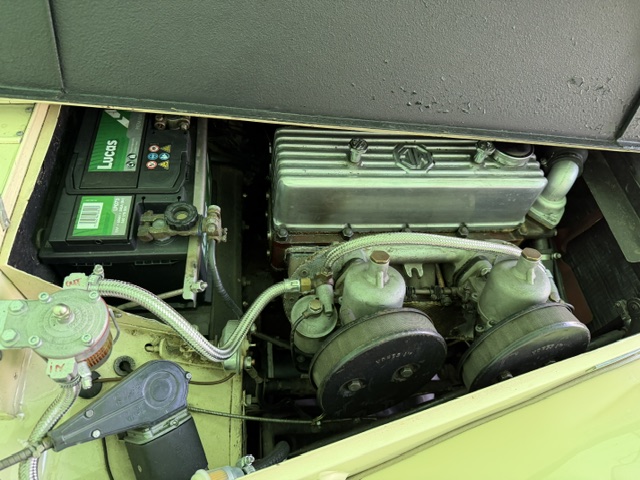
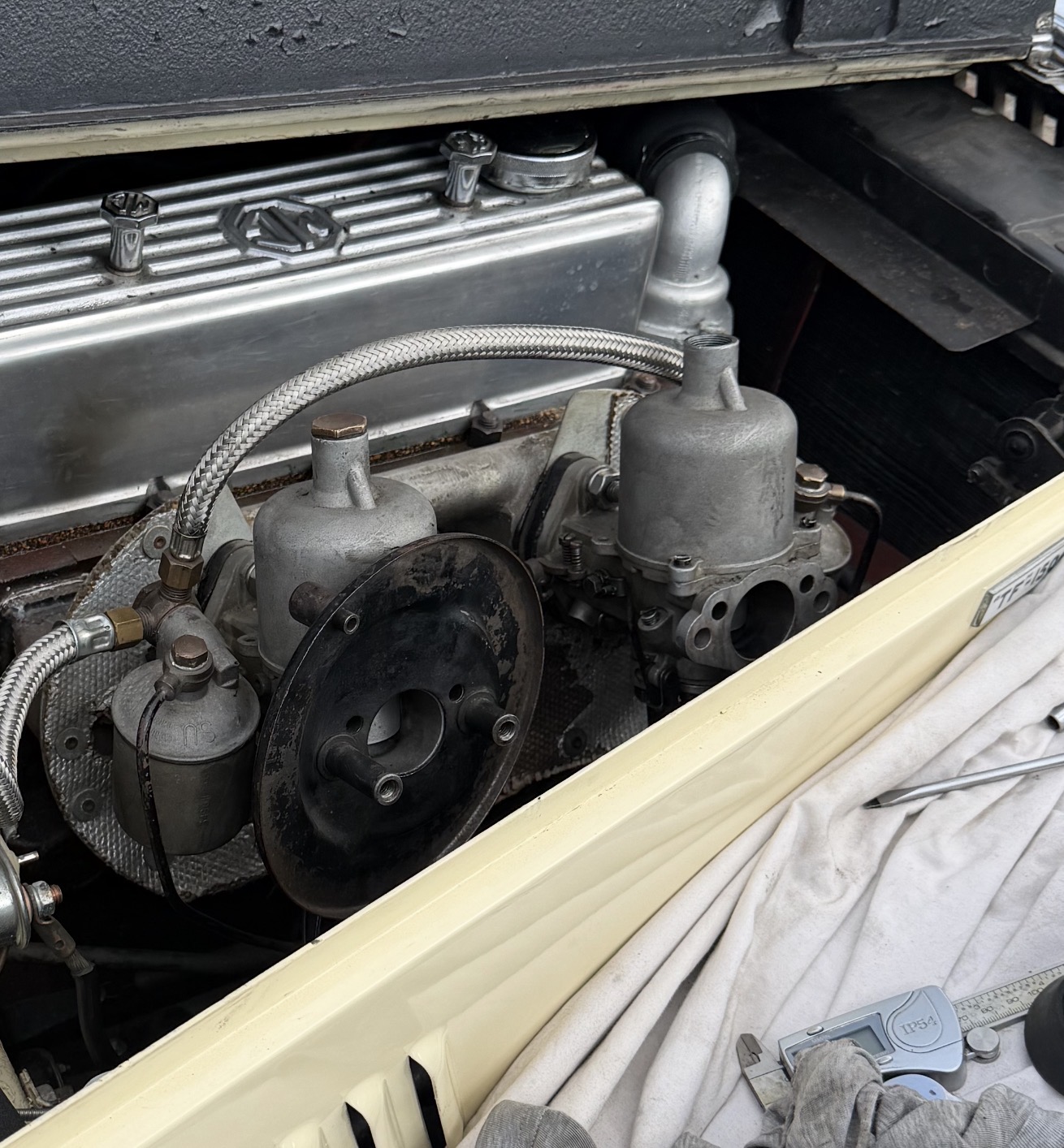
The XPAG is an over-square iron-block, iron-head pushrod four with three main bearings, driven by a duplex chain and fed by twin H-type SU carburettors on a shared inlet manifold. The standard figures below are as published by Eric Blower in *Motoring* (the MG Car Company magazine), July 1957, condensing the factory tuning booklets.
| Item | Figure |
|---|---|
| Bore x stroke | 66.5 mm x 90 mm |
| Capacity | 1250 cc |
| Cylinders | Four, in-line, pushrod OHV |
| Main bearings | Three |
| Compression ratio | 7.25:1 |
| Firing order | 1-3-4-2 |
| Valve lift | 8 mm |
| Combustion space | 45.5 cc |
| Cylinder head depth | 76.75 mm |
| Head gasket | .045 in, approx 4.5 cc compressed |
| Carburettors | Twin SU 1.25 in bore |
| Jets | .090 in |
| Needles | Standard ES, richer EM, weaker AP |
| BMEP | 125 at 2,600 rpm |
| Safe maximum revs | 5,700 rpm |
| Valve crash | 6,000 rpm |
| Octane | 74 minimum for knock-free running; 82 for maximum power |
Settings that changed partway through production
This is where generic advice breaks down. MG revised four settings at specific engine numbers during TD2 production, and using the wrong side of the split will give you a wrong-sounding engine even if everything else is right.
| Setting | Up to engine number | From engine number |
|---|---|---|
| Spark plugs | Champion L10S to XPAG/TD2/22734 | Champion NA8 from XPAG/TD2/22735 |
| Tappet clearance | .019 in to XPAG/TD2/24115 | .012 in from XPAG/TD2/24116 |
| Contact breaker points gap | .010–.012 in to XPAG/TD2/24488 | .014–.016 in from XPAG/TD2/24489 |
| Cylinder head (round water holes) | , | introduced at XPAG/TD2/22735 |
Check your engine number against every row before ordering parts or setting clearances.
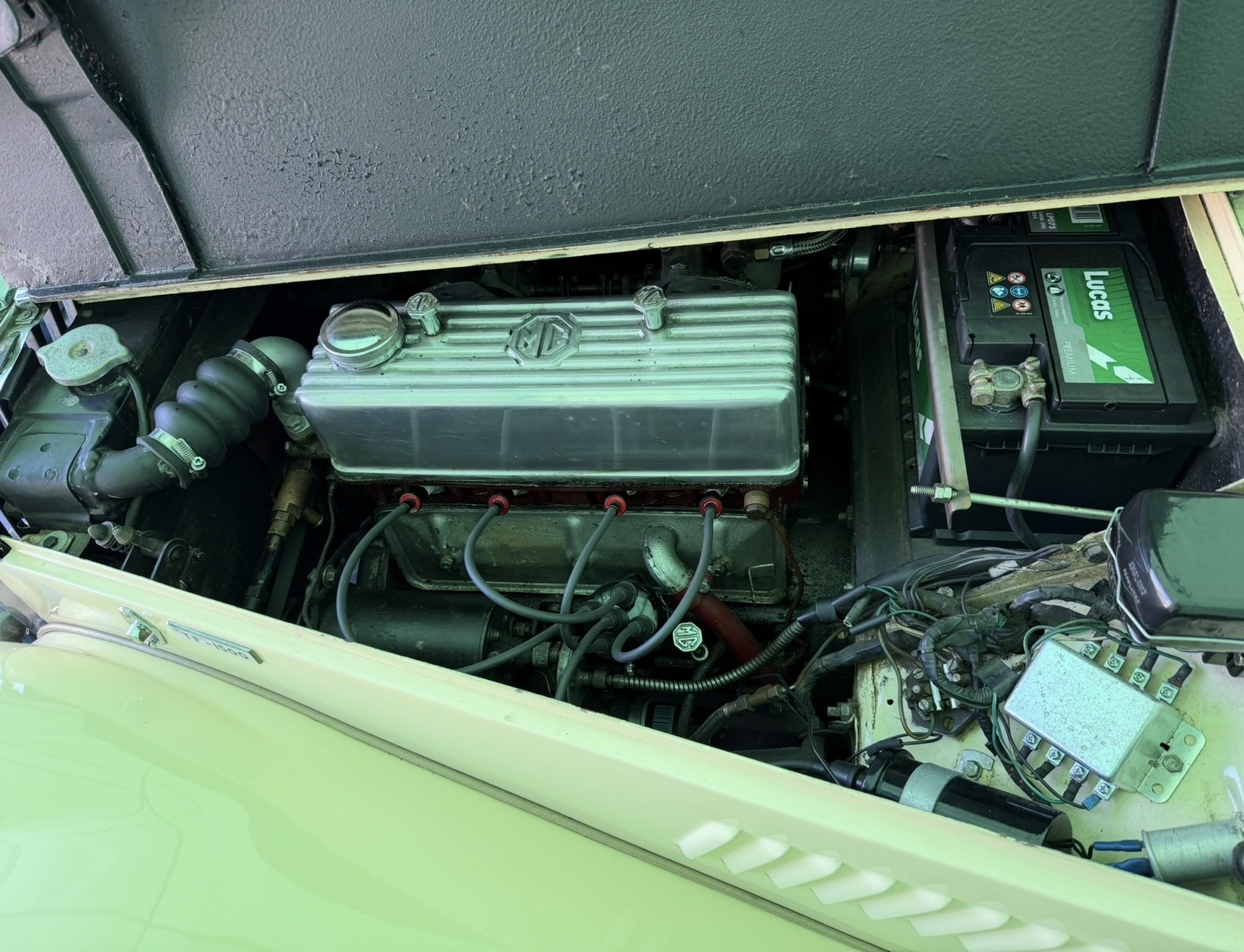
Ignition timing, TDC, not BTDC
Set the ignition at top dead centre, fully retarded, with the points just breaking. That is the factory figure quoted by Blower for the standard XPAG. It is not a BTDC static-timing figure and any advice that quotes a specific number of degrees before TDC for a standard road XPAG should be treated with suspicion, refer to the workshop manual for your engine number and check on the car.
Interactive decision tree
Misfire, hesitation or hot starting, routed to the right stage
10 steps
Which symptom are you chasing?
Pick the one that best matches. You'll be asked which tune stage you're running before we get to the fix.
Which tune are you running?
When does the misfire actually appear?
Cause follows the pattern. On a Stage 1 XPAG, misfire is almost always ignition, not carburation.
Only under load or uphill
Next step
Weak spark under cylinder pressure, condenser and points first
Fit a fresh condenser (they age out and are the single most common cause), set points to 0.015 in (60° dwell), and verify static timing at 5° BTDC. Clean the plugs to a light tan. If it still misfires under load, check the coil with a multimeter (3–4 Ω primary, 6–10 kΩ secondary on a standard 12 V coil).
Ignition & charging guide →Only at high revs (above ~4,500 rpm)
Next step
Points bounce, replace points or fit electronic ignition
The original centrifugal-advance distributor's point spring softens with age. Fit new points, confirm 0.015 in gap and 60° dwell, and if it returns consider an electronic conversion (Accuspark, Pertronix). Stage 1 doesn't need it, but it kills point-bounce misfire cleanly.
Ignition & charging guide →Random / intermittent, worse in the wet
Do this
HT tracking, cap, rotor and leads
Do a bonnet-up check in the dark with the engine running: any blue arcing at the cap, rotor tip or leads is tracking. Replace the cap and rotor as a pair, fit copper-core silicone leads, and dry the distributor internals. A dose of WD-40 on assembly buys you months.
How does the Stage 2 misfire behave?
Stage 2 XPAGs are less forgiving of setup, the fix is usually in the tune, not in worn parts.
Feels flat under load, no fireworks, just dull
Next step
Check the total advance on a rolling road
Stage 2 wants ~32° all-in by 3,000 rpm with roughly 8–10° static, but the exact curve depends on your cam and compression. Guessing costs pistons. Book a rolling-road session and have the distributor curved for the engine. This is non-negotiable at Stage 2.
SU carburettor tuning →Only misfires when fully hot
Do this
Plug heat range and valve clearances
Drop one heat range (NGK BP6ES → BP7ES on most Stage 2 XPAGs). Then check valve clearances hot at 0.019 in inlet and exhaust, tight exhausts on a Stage 2 cam will burn a valve and misfire when hot long before they hole it.
Complete tune-up procedure →Rough idle, misses at tickover
Next step
1.5 in SU balance, mixture and cam overlap
Stage 2 cams hate small throttle openings. Balance the 1.5 in SUs with a flow meter, reset mixture 12 flats down from bridge, then raise idle to ~900 rpm, a lumpy 700 rpm idle isn't a fault, it's the cam. Also check for a manifold air leak at the head face; a Stage 2 head is often re-faced and the studs need re-torquing.
SU carburettor tuning →Which tune are you running?
What does the flat spot feel like when you snap the throttle open?
A dead flat second, then it picks up
Do this
SU dashpot damper oil, the classic Stage 1 miss
Unscrew the brass cap on top of each SU carburettor and top up the dashpot to within 1/2 in of the top with 20W engine oil (SAE 20 or ordinary 20W-50). Check the piston lifts smoothly with a finger, sticking pistons cause the same symptom and mean a dirty dashpot bore that needs cleaning with paraffin.
SU Type H maintenance →Spits back through the carburettor mouth
Next step
Weak mixture, enrich by one flat at a time
Weak-mixture spit-back on Stage 1 usually means the jet's dropped by a flat or the needle is worn. Screw the jet adjusting nut down (richer) one flat, warm the engine, and lift the piston 1/32 in with the lifting pin, revs should rise slightly then settle. If not, screw down another flat. Also check the manifold-to-head gasket for air leaks, same symptom, different cause.
SU tuning procedure →Pops in the exhaust on the overrun
Next step
Rich mixture or retarded ignition
Confirm static timing at 5° BTDC first, a slipped distributor clamp bolt is the classic cause. Then do the lifting-pin test: if revs rise and stay high, you're rich. Screw the jet adjusting nut up (leaner) one flat at a time until the lift produces a small rise that settles back.
Stage 1 timing figures →Where in the rev range does the Stage 2 hesitation appear?
On Stage 2 the fix almost always lives in the distributor advance curve or the SU needle profile, both need a rolling road to sort properly.
Flat spot at 2,000–3,000 rpm under acceleration
Next step
Distributor advance curve wrong for the cam
A stock 25D4 curve pulls advance in too slowly for a Stage 2 cam. Typical target: ~15° mechanical advance in by 3,000 rpm, static around 8–10°, total ~32° all-in. This is not adjustable at the roadside, it requires bob-weights and springs matched on a distributor machine or dialled in on a rolling road.
Tune-up procedure →Won't pull cleanly past 4,500 rpm
Next step
Needle profile too rich in the top third
Stage 2 XPAGs on 1.5 in SUs often need a weaker top-end needle. Try one step leaner (for example AN → GG on H4s) and re-check on a rolling road. Do not swap needles by eye, an over-lean top end will melt a piston crown in ten miles.
SU carb tuning →Lumpy, hunting mixture at 1,500–2,000 rpm
Next step
Part-throttle needle mid-section and manifold match
Hunting at light load is a Stage 2 needle mid-section problem, made worse by an unmatched manifold. Check that your inlet manifold ports have been opened to match the head (gasket alignment is not enough) and pick a needle with a straighter mid-section, a rolling road is the cheapest way to get there.
Stage 2 head & manifold notes →Which tune are you running?
What does the hot-start failure look like?
Hot-starting problems on an XPAG are almost always fuel percolation, the petrol in the float chambers boils after shut-down.
Cranks fine, won't fire for 10–20 seconds
Do this
Fuel percolation, fit a heat shield and lag the fuel line
Fit an alloy heat-shield between the exhaust manifold and the SU float chambers, lag the fuel line where it runs down the bulkhead, and switch on the ignition for 15–20 seconds before cranking so the SU pump can refill the chambers. This alone cures 90% of Stage 1 hot-starting problems.
SU fuel pump roadside guide →Cranks slowly, battery seems flat
Next step
Hot-soaked earth and starter
Heat raises electrical resistance and the T-Series chassis earth strap oxidises. Clean the chassis-to-engine and chassis-to-body earth points back to bright metal, refit with star washers, and check the starter solenoid connections. If it persists, a modern higher-CCA 6 V or 12 V battery matched to the loom will crank hot.
Fires immediately then stalls
Next step
Float level too high, fuel flooding the jets
Percolated fuel expands in the float chamber, lifts the jet flooding point and richens dramatically at first crank. Reset the float level to 7/16 in below the chamber lid, check both floats sink at the same rate (a punctured brass float is a classic on unrestored cars), and verify the needle valves close cleanly.
SU Type H float setup →What does the Stage 2 hot-start failure look like?
LCB manifolds and higher compression make percolation worse, the fix is usually thermal, not carburation.
Cranks and cranks, no fire at all
Do this
Aggravated percolation, ceramic-coat or wrap the manifold
The LCB manifold radiates far more heat into the float chambers than a stock exhaust. Ceramic-coat or wrap the LCB, fit an alloy heat-shield, and lag the fuel line. Some Stage 2 owners fit a small return line to the tank to keep the fuel cool, worth doing if you drive in traffic in summer.
Fires but runs rich for the first minute
Next step
Rolling-road weak-mid needle usually fixes both problems
Stage 2 needles fitted 'for cold start' are often too rich in the mid-range, which shows up as hot-start richness after percolation and as the 1,500–2,000 rpm hunting you may already have noticed. A rolling-road-selected weak-mid needle typically cures both at once.
SU carb tuning →Fires immediately then dies
Next step
High float level plus heat
Reset the float level to 7/16 in, check both floats sink at equal rate, and, because Stage 2 heads run hotter under the bonnet, verify the needle valves are the newer viton-tipped type. Brass-tipped valves stick partly open when hot.
SU Type H float setup →Block and head castings, why it matters
W.K.F. Wood's *The XPAG Engine: Data, Service, Supertuning* records two distinct water-passage patterns in the XPAG block and head:
- "Banana"-shaped water passages, TB, TC and early TD up to engine number XPAG/TD2/17969.
- "Round" water holes, with a bridge across the passage behind the rear cylinder, later TD and all TF.
- A cylinder head with round water passages was introduced at XPAG/TD2/22735.
If you are buying a used head or a head gasket, this is the first thing to check. A round-hole head on a banana-passage block (or vice versa) with the wrong gasket will either leak, or route coolant incorrectly around the rear cylinder, a leading cause of localised overheating on rebuilt cars. Match the head, the block and the gasket to each other, using the engine number as the reference.
Model variations
The MG Car Club Y-Type Register XPAG Files record the following variations on the standard engine, drawn on for this section:
- The TD used the standard 7.25:1 compression ratio quoted above.
- The TD Mk II raised compression to 8:1, giving 60 bhp.
- The TF 1250 engine was effectively the TD Mk II unit, about 4 bhp up on the standard TD, producing 57 bhp.
- The XPEG (fitted to the TF 1500) was created by re-coring the block to allow boring to 72 mm, giving 1466 cc.
- The TF 1500 head was the TD2 head with larger valves: inlet 36 mm (TD 33 mm), exhaust 34 mm (TD 31 mm).
- The 8 in clutch replaced the earlier 7.25 in unit at SC2/16916 and TD2/9408.
Factory tuning stages (historical record)
The three tuning stages below are the MG Car Company's own factory figures as published by Blower in 1957. They are presented here as historical record, not as instructions to follow on a road car. Every figure was arrived at on 1950s fuel and 1950s tolerances, on new engines. Do not lift them straight onto a seventy-year-old block without expert advice, see the modern fuel note at the foot of this article.
Stage 1, 60 bhp at 5,500 rpm
- Compression raised to 8.6:1 by machining the head face to 74.37 mm depth.
- Polish the combustion chambers, do not grind them out.
- Ports may be ground and polished without impairing shape or valve choke diameter.
- Fit washers under the head stud nuts and mild steel rocker shaft packing pieces to correct for the reduced head thickness.
- Tappets may be opened to .022 in on engines up to XPAG/TD2/24115.
- Plugs: Champion L10 or Lodge R49.
- Standard carburettors, needles and jets.
- Ignition at the standard setting (TDC).
- Requires high-octane fuel.
Stage 2, 66.5 bhp at 5,500 rpm (68 bhp with 1.5 in SUs)
- Compression 9.3:1 by machining the head face to 73.575 mm, described by MG as the absolute maximum to remove.
- Larger valves. Inlet: 36 mm heads, choke bored to 33 mm, seat recut 30 degrees by 34.9 mm top diameter. Exhaust: 34 mm heads, choke 29 mm, seat 30 degrees by 32.8 mm.
- Competition valve springs of 150 lb open tension, closed coils next to the head. Valve crash then occurs around 6,500 rpm.
- With 1.5 in competition carburettors and the EL needle (richer AA, weaker EO): 68 bhp at 5,500 rpm.
- MG noted the fan absorbs about 1 bhp and may be removed if the car is driven generally above 40 mph, but should be retained for trials, slow hill-climbing and traffic.
Stage 3, 74–83 bhp (competition specification, methanol fuel)
Stage 3 is included here for completeness only. It is a competition specification running on a methanol-based fuel, not a road tune, and it must not be attempted on a road car.
- 12:1 compression using special pistons on the standard 76.75 mm head.
- Fuel: 80% methanol, 10% benzol, 10% petrol, 1% castor oil.
- Jets .100 in, GK needles.
- Plugs: Champion L14 or Lodge R49.
- SU type T3 float chamber needle and seat.
- Two SU pumps with duplicate fuel lines.
- Outputs: 74 bhp at 5,800 rpm; 76 bhp with the larger valves; 80 bhp at 6,000 rpm with 1.5 in competition carburettors, .125 in jets and VE needles; 83 bhp at 6,000 rpm on 100% methanol with VJ needles.
Rebore table
The MG Car Company's guidance on rebore sizes, from the same 1957 source:
| Bore oversize | Capacity | Compression ratio | Notes |
|---|---|---|---|
| Standard | 1250 cc | 7.25 | , |
| +.010 in | 1260 cc | 7.3 | , |
| +.050 in | 1299 cc | 7.50 | , |
| +.060 in | 1309 cc | 7.54 | , |
| +.080 in | 1328 cc | 7.64 | Not recommended by MG, independent pistons only |
| +.100 in | 1348 cc | 7.74 | Not recommended by MG, independent pistons only |
| +.120 in | 1368 cc | 7.84 | Not recommended by MG, independent pistons only |
Crankshaft, a known weak point
The XPAG/XPEG crankshaft is a documented weak point. Cracks are well recorded in service, most commonly at the front (number one) journal. Any rebuild that does not crack-test the crankshaft is not a rebuild.
Modern fuel caveat
All the figures on this page date from the 1950s and assume the fuels of that era, leaded petrol at 74–100 octane, with none of the volatility or ethanol behaviour of today's pump fuel.
Modern E5 and E10 petrol differs in octane rating, volatility and ethanol content. That changes how the engine starts hot, how the carburettors meter through the mid-range, and how the ignition wants to be timed. Settings drawn straight from a 1957 booklet will need adjustment on modern fuel, and it is worth taking specialist advice before deciding what to change.
See the SU carburettor tuning guide and the SU electric fuel pump guide for the fuel-side of the equation.
Always confirm against the workshop manual
Every figure here was consulted against the sources listed below in July 2026 and matched to the engine-number ranges quoted by MG. Even so, the responsibility for what goes on your engine sits with you.
Before any work is carried out, confirm the settings against the official MG workshop manual for your specific engine number. If the manual disagrees with this page for your engine, the manual wins.
FAQ
What ignition timing should I use on a standard XPAG?
Top dead centre, fully retarded, with the points just breaking. That is the factory setting quoted by Blower in 1957 for the standard XPAG. It is not a BTDC static figure.
What tappet clearance does my XPAG want?
.019 in up to engine number XPAG/TD2/24115. From XPAG/TD2/24116 onwards, .012 in. Confirm your engine number before setting clearances.
What spark plugs are correct?
Champion L10S up to XPAG/TD2/22734. Champion NA8 from XPAG/TD2/22735. Stage 1 uses Champion L10 or Lodge R49; Stage 3 uses Champion L14 or Lodge R49.
What contact-breaker points gap should I use?
.010–.012 in up to XPAG/TD2/24488. .014–.016 in from XPAG/TD2/24489.
What are the standard SU jets and needles?
.090 in jets. Standard needle ES, richer EM, weaker AP. Stage 2 with 1.5 in competition SUs uses needle EL (richer AA, weaker EO).
Is regrinding an XPEG crank safe?
The TD/TF workshop manual did not permit regrinding the XPEG crankshaft. Crack-test at rebuild and take specialist advice.
What's the safe rev limit?
5,700 rpm safe maximum, valve crash at 6,000 rpm on the standard engine. Competition Stage 2 valve springs push valve crash to about 6,500 rpm.
Sources
- Eric Blower, "Tuning the XPAG Engines fitted to the Series TB, TC and TD," *Motoring* (the MG Car Company's own magazine), July 1957, condensing the original factory tuning booklets. Primary source for all factory tuning stages, standard specification, engine-number breakpoints and the rebore table.
- W.K.F. Wood, *The XPAG Engine: Data, Service, Supertuning*, primary source for the "banana" versus "round" water-passage block and head castings.
- MG Car Club Y-Type Register, XPAG Files, source for TD Mk II, TF 1250 and TF 1500 / XPEG variations, valve sizes and clutch changeover engine numbers.
Figures were consulted against these sources in July 2026.
Frequently asked questions
What are Stage 1 and Stage 2 tune for the XPAG?
Stage 1 is a bolt-on road tune: a properly rebuilt distributor with the correct advance curve, twin 1.25 in H-type SUs balanced and jetted correctly, a free-flow exhaust manifold and a decent air filter. Stage 2 adds a mildly ported head, a raised compression ratio (typically 8.3–8.6:1 on the TD/TF; 7.5:1 on high-compression XPEG), a fast-road camshaft with matched valve springs, and larger 1.5 in SUs on a matched inlet manifold. Stage 2 needs re-timing, re-jetting and a rolling-road session. It is not a bolt-on.
How much power does a tuned XPAG make?
As a rough guide: standard TD 54 bhp, standard TF 1250 57 bhp, standard TF 1500 63 bhp; a well-executed Stage 1 tune typically reads 65–72 bhp at the flywheel, and a Stage 2 head, cam and 1.5 in SU package will show 80–90 bhp on a rolling road. Numbers above that usually mean the engine is being over-revved or has been supercharged, both are hard on a 70-year-old bottom end.
How do I balance twin SU carburettors on an MG?
Warm the engine, disconnect the throttle interconnect and jet linkage so each carb runs independently, place an airflow meter (Unisyn or STE Synchrocheck) over each intake in turn and adjust the throttle-stop screws until both draw the same reading at 700–800 rpm. Then set the mixture on both jets equally, reconnect the linkages and re-check. Do this only after the ignition is right, an unbalanced SU is almost always downstream of a bad points, timing or plug fault.
What ignition timing does a tuned XPAG need?
Standard static timing is 4° BTDC on TB/TC, 6° BTDC on TD, 5° BTDC on TF. On modern 95 RON petrol many tuned XPAGs run cleanest with the static a few degrees advanced (up to about 8–10° BTDC), provided the engine does not pink under load. On a raised-compression Stage 2 engine, static timing should be set on the dyno, the correct figure will depend on the camshaft and the head's chamber shape.
Is it safe to tune an XPAG?
The XPAG was designed as a tuneable engine. It is the block that Abingdon used for its own Le Mans, record-breaker and Stage-tuned road cars in period, and the block Shorrock, Judson and Marshall built their supercharger kits around. A sensible Stage 1 tune actually lengthens engine life if the ignition and mixture end up correct. What kills XPAGs is over-revving, ignition pink on a raised-compression engine, and running lean at wide throttle, all of which are tuning faults, not engine faults.
Why does my tuned XPAG misfire under load?
Misfire under load is almost always ignition on an XPAG, not carburation. Check the plug gaps and colour first, sooty plugs mean the mixture is rich or the ignition is weak; white or blistered electrodes mean it is lean. Then confirm the points gap and dwell, the rotor arm and condenser, and that the coil is producing a strong blue spark. On a Stage 1 or Stage 2 engine, also check the static timing has not crept too far advanced; a pinking engine often feels like a misfire and will eventually burn a hole in a piston. Finally, balance the SUs again, an unbalanced pair can leave one cylinder running lean enough to misfire at wide throttle.
Why does my XPAG hesitate when I open the throttle?
Hesitation on pick-up is the classic SU weak-mixture signal. The piston in the carburettor is lifting too fast for the fuel to follow, usually because the jet is set too lean, the needle is worn, or the dashpot oil is too thin. On a Stage 1 car with standard 1.25 in SUs, start by checking the damper oil level and weight, SAE 20 is correct, and that the piston rises smoothly without sticking. Then richen each jet by one flat, test again, and confirm with the lifting-pin method. On a Stage 2 car with 1.5 in SUs the same rule applies, but the needle profile is more critical; a worn or mismatched needle will hesitate whatever the jet setting.
Why is my tuned XPAG hard to start when hot?
Hot-starting problems on a tuned XPAG usually come down to fuel evaporation or flooding. A free-flow exhaust and a hot engine bay can boil the fuel in the float chamber and carburettor body, making the mixture over-rich. Check the float level first. It should be at the workshop-manual figure, not simply 'looks about right'. If the car starts cold but floods hot, try easing the throttle fully open while cranking to clear the cylinders, then start with no throttle. On Stage 2 engines with raised compression the starter also has to turn a higher-compression engine against a hot block; a good battery and clean earth straps matter more than on a standard car.
My Stage 1 XPAG pings on acceleration, what do I adjust?
Pinking means the combustion pressure peak is arriving too early. On a Stage 1 tune running on modern 95 RON petrol, retard the static timing by one or two degrees first and re-test on a warm day under load. If it still pings, check that someone has not already advanced the distributor beyond the Stage 1 figure, verify the compression ratio has not been raised by a previous skim, and make sure you are not running the engine below about 1,500 rpm in a high gear. Do not simply richen the mixture to mask pinking. It helps a little, but the real fix is timing or compression.
After fitting 1.5 in SUs my Stage 2 idle hunts, what is wrong?
An uneven idle after a Stage 2 carburettor swap is usually one of three things: the throttle spindles are worn and drawing air, the inlet manifold is not matched to the head ports and is causing reversion pulses, or the jets and needles are not centred and matched. Re-check the manifold face and gasket match, recentre both jets with the piston-drop test, and confirm both carburettors are drawing the same airflow at idle. Stage 2 engines with a fast-road cam also have less manifold vacuum at idle, so the idle speed may need to be set a little higher than standard, typically 800–900 rpm, to keep the SUs stable.
How do I know if my tune is running lean?
Lean running shows up as a flat spot under load, popping in the exhaust on the overrun, white or grey spark-plug insulators, and elevated exhaust-manifold colour after a run. On a rolling road the air/fuel ratio will read above 14.5:1 at cruise or above 13.0:1 at wide throttle. Fix it by richening the mixture a flat at a time on the SUs, checking for air leaks around the manifold and balance pipe, and confirming the fuel pump is delivering at least 1.5 psi at the carbs. Lean mixture is the fastest way to burn exhaust valves on a tuned XPAG, so do not ignore it.