1945–1949
MG TC
The car that put MG on the American map.
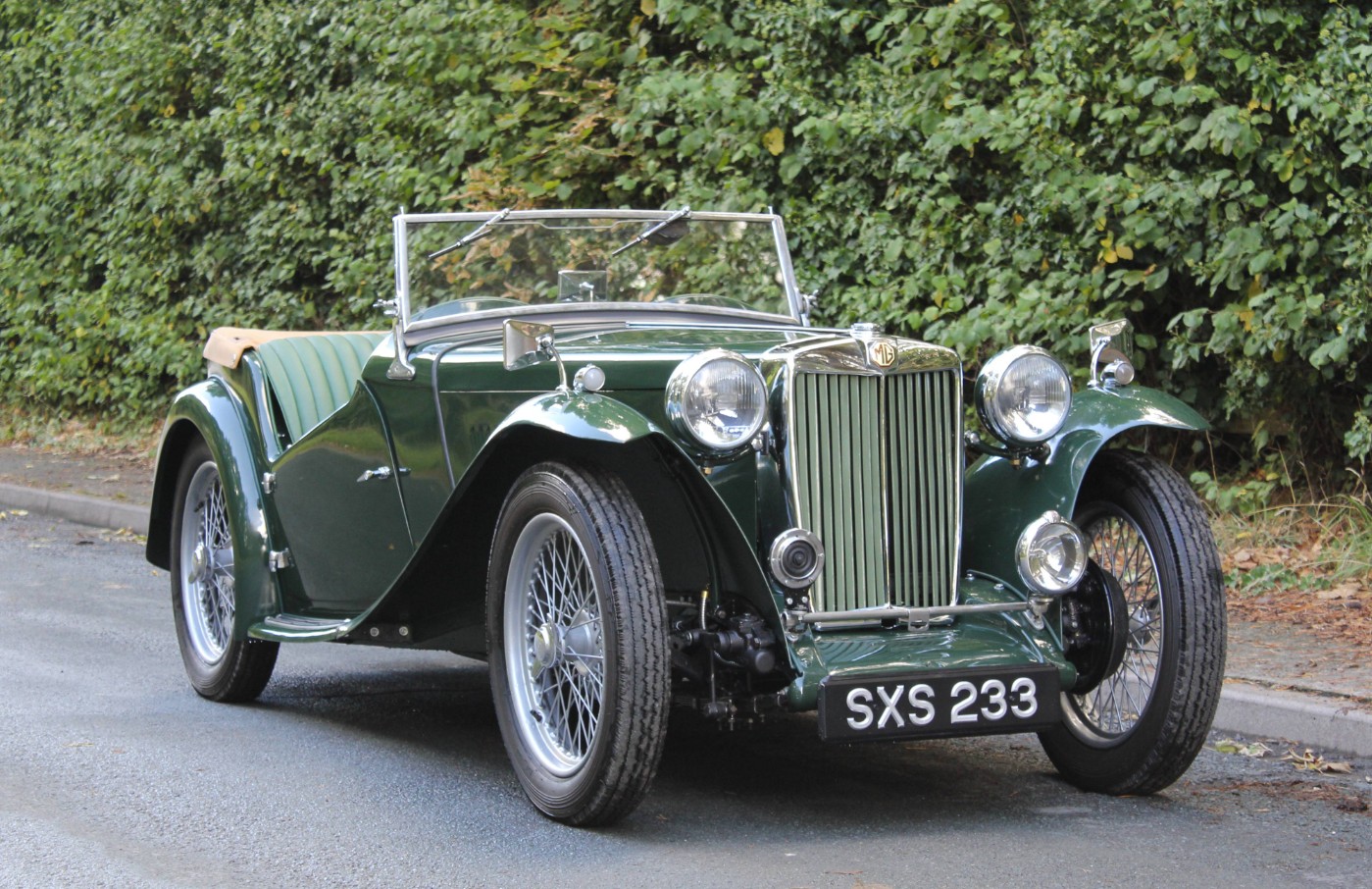
The MG TC of 1945–1949 was the first post-war MG, a lightly revised TB with the 1,250 cc XPAG engine at 7.4:1 compression and 54.5 bhp at 5,200 rpm. Around 10,000 were built, all right-hand drive, and a large share went to the United States, where the TC is widely credited with creating the American sports-car market.
- Years
- 1945–1949
- Engine
- XPAG
- Capacity
- 1,250 cc
- Power
- 54.5 bhp @ 5,200 rpm
- Approximate built
- 10,001
For the story of the engine itself, its Morris origins, specifications, the enlarged XPEG and its known weak spots, see the XPAG engine hub.
To place a particular car, see how to read its chassis and engine numbers.
Every T-Type body tub is built on wood, so the condition of the ash frame matters more than almost anything else.
The first post-war MG
Launched in September 1945, the TC was the car with which MG restarted production after six years of war work at Abingdon. It was mechanically and visually very close to the TB of 1939, because that was the point: MG needed a car it could build immediately with tooling it already had, and the T-Type was ready. The result is that a TC is in every meaningful sense a pre-war design sold into a post-war market, which is exactly what gives it its character.
A wider body over the TB
The clearest change from the TB is the body tub, which was widened to give more room across the cockpit, the only obvious visual difference between the two cars. No factory comparison of TB and TC tub widths is published here, because the TB figure could not be traced to a named source; the TC's own overall width is given in the specification table below. Anyone needing the two side by side should ask the MG Car Club T Register's registrar rather than trust a figure found online.
The XPAG in TC form
The 1,250 cc XPAG is the engine the TB introduced and the TC carried on: four cylinders, overhead valves, three main bearings, 66.5 mm bore and 90 mm stroke. In TC form it ran twin SU semi-downdraught carburettors of 1¼ in, smaller than the 1½ in instruments of the TD and TF, and produced around 54.5 bhp at 5,200 rpm. The earliest TC engines are of the banana-block type, with banana-shaped water passages, before the change to the round water holes of the later cars. The factory published several alternative stages of tune, and the XPAG became renowned in period, and remains renowned today, for its tunability.
Beam axle, cam steering, and what that feels like
Under the TC is the traditional layout the TD would sweep away: a beam front axle on half-elliptic leaf springs, a live rear axle on half-elliptic springs, lever-arm hydraulic dampers, and a Bishop cam steering box rather than a rack. Lockheed hydraulic drums of 9 in are fitted all round. On the road that combination is firm, direct and unmistakably vintage, which is the whole appeal for most TC owners and the reason others prefer a TD. A TC with independent front suspension or rack-and-pinion steering has been modified; neither belongs to the model.
Nineteen-inch centre-lock wire wheels
The TC rides on 19 in centre-lock wire wheels with knock-off hubs, on 4.50–19 crossply tyres. This is the exact inverse of the TD, which left Abingdon on bolt-on pressed-steel disc wheels and never offered wires at all, and the confusion between the two catches people out regularly. On a TC the wires, their spinners and the tyre type are what a correct car carries. They are also the expensive part: spokes, rim runout and worn hub splines are all worth assessing before purchase, since a wheel rebuild is a real cost rather than a detail.
Body, tub and timber
The body is a steel-panelled tub over an ash frame, as on every T-Type, and the timber is the single most expensive thing to get wrong on a restoration. The details are the ones that give the breed its silhouette: cutaway doors, running boards, a fold-flat windscreen, a slab-style rear fuel tank with the spare wheel mounted on it, and a slatted grille carrying the octagon badge. The TC carried no bumpers, where the TD would gain chromed bumpers with overriders as standard equipment.
Right-hand drive, and America anyway
Every TC was built as right-hand drive. MG never made a factory left-hand-drive TC, which makes any left-hand-drive example a conversion rather than an original car. That fact sits oddly beside the model's reputation, because a large share of later production was exported and American servicemen returning from Europe brought TCs home in numbers. The car arrived in the United States without ever being engineered for it. No verified market-by-market export breakdown is published, so none is given here.
The car that made the American sports car
The TC is routinely credited with founding the American sports-car market, and its influence is out of all proportion to a run of 10,001 cars. Its arrival fed directly into the SCCA racing scene, the American MG clubs, and the export thinking that produced the TD and later the MGA. Left-hand drive from the factory, which the TD introduced, was the commercial answer to a demand the TC had created by accident.
Numbers, colours and the record
Chassis numbers run from TC0251 to TC10251, stamped on the near-side chassis dumb-iron and repeated on the plate under the bonnet, while engines carry a plain XPAG prefix with no TC-specific suffix. There is therefore no way to establish from the block alone whether an engine is the one the car left Abingdon with, and later TD or TF units in TCs are common. Colours are the same kind of question: the TC was offered in a range of factory colours and trims, and no list is asserted here because the authority for a given car is its own BMIHT Heritage Certificate cross-checked against the T Register's production records.
Between the TB and the TD
Placed either side, the TC is the hinge between pre-war and post-war MG. Against the TB it offers the same XPAG engine and dry-plate clutch in a wider body, built in numbers the TB never had the chance to reach: 379 TBs against 10,001 TCs. Against the TD it gives up independent front suspension, rack-and-pinion steering, standard bumpers, a hypoid axle and factory left-hand drive, keeping centre-lock wire wheels and a vintage directness that many owners specifically want. The TD is the easier car to use and much the better supported; the TC is the more romantic, and usually the more valuable.
Full reference
MG TC specification and identification
Everything needed to identify, evaluate and understand an MG TC in one place: factory specification, chassis and engine number practice, production figures, parts and running notes, the checks that matter on a viewing, and current value bands.
Factory specification
Engine
| Type | XPAG, four cylinders in line, overhead valve, three main bearings |
|---|---|
| Capacity | 1,250 cc |
| Bore × stroke | 66.5 mm × 90 mm (2.618 in × 3.543 in) |
| Compression ratio | 7.4:1 as usually quoted for the TC; some reprints give 7.25:1, and export cars could be supplied differently, check the head fitted to the car in front of you |
| Power | 54.5 bhp at 5,200 rpm (figure appears as 54, 54.4 and 54.5 bhp in different reprints of the same factory data) |
| Carburettors | Twin SU semi-downdraught, 1¼ in (H2) per MG Car Club XPAG technical data, not the larger 1½ in instruments of the TD and TF |
| Torque | Not given here: the commonly circulated ~64 lb ft figure could not be traced to a factory table |
Transmission
| Gearbox | Four speed, synchromesh on second, third and top, right-hand remote change |
|---|---|
| Overall ratios (with 5.125 axle) | Top 5.125, third 6.92, second 10.0, first 17.32, reverse 17.32 |
| Final drive | 5.125:1 standard spiral bevel; 4.875:1 and 5.375:1 offered for competition and export use |
| Clutch | 7¼ in Borg & Beck single dry plate (secondary sources only, confirm against the Workshop Manual) |
Chassis and brakes
| Chassis | Ladder frame with box-section side members, underslung at the rear; ash-framed body tub with steel panelling |
|---|---|
| Front suspension | Beam axle on half-elliptic leaf springs with hydraulic lever-arm dampers, no independent front suspension |
| Rear suspension | Live axle on half-elliptic leaf springs, hydraulic lever-arm dampers |
| Steering | Bishop cam steering box. Rack and pinion did not arrive until the TD |
| Brakes | Lockheed hydraulic drums all round, 9 in diameter |
| Wheels and tyres | 19 in centre-lock wire wheels, 4.50–19 crossply. Pressures are not quoted here, take them from the Drivers' Handbook |
Dimensions and weight
| Wheelbase | 94 in (7 ft 10 in / 2,388 mm) |
|---|---|
| Track, front and rear | 45 in (3 ft 9 in / 1,143 mm) |
| Overall length | 144.5 in (12 ft 0½ in / 3,670 mm) |
| Overall width | 56 in (4 ft 8 in / 1,422 mm) |
| Overall height, hood erect | 53 in (4 ft 5 in / 1,352 mm) |
| Ground clearance | 6 in |
| Weight, unladen | 15.5 cwt, approximately 1,735 lb (787 kg) |
Capacities
| Fuel tank | 13.5 imperial gallons (61 litres) |
|---|---|
| Oil, coolant and brake fluid | Deliberately not quoted: no named source for the TC's capacities could be confirmed. Take them from the Workshop Manual for your car |
Top speed and 0–60 mph figures for the TC circulate widely, usually around 78 mph and 22.7 seconds, but none of them could be traced to a named, dated issue of The Autocar or The Motor, so no performance figure is stated here. Period tests generally place TC top speeds in the mid-to-high seventies depending on gearing and tune; the original test report or Clausager, which reproduces period data with issue dates, is the source worth trusting.
Sources for these figures
- MG Owners’ Club MG TC guide, engine data and production total (10,001 cars).
- MG Car Club Y Register XPAG technical data pages, carburettor type, gearbox and axle ratios.
- W.K.F. Wood, “The XPAG Engine” (1968; club reprint), engine construction and main bearings.
- MG Car Club T Register, chassis and engine identification, and the T Type Factory Production Records.
- Dimensional figures are consistent across multiple published compilations but were not read off an original factory data sheet, treat them as reliable rather than definitive.
Chassis and engine number identification
Chassis numbers
TC numbers run from TC0251, the first production car of September 1945, to TC10251, the last of November 1949, 10,001 cars numbered straight through. The number is stamped on the near-side chassis dumb-iron at the front and repeated on the plate riveted under the bonnet; the two should agree with each other and with the factory record.
Engine numbers
TC engines carry a plain XPAG prefix and serial, stamped on the block and shown on a plate on the bellhousing above the starter. There is no TC-specific engine suffix, which makes the factory record the only reliable way to establish whether an engine is the one the car left Abingdon with. A later TD or TF XPAG in a TC is common and materially affects value.
Confirming a car against the factory record
The MG Car Club T Register holds the searchable T Type Factory Production Records, which return the original build date and engine number for a given chassis number. Treat any claim of matching numbers as unproven until it agrees with that record.
Full number formats for every T-Type are set out in Chassis & Engine Number Identification, and the lookup procedure in Production Records.
Production figures
| Total built | 10,001 |
|---|---|
| Chassis number range | TC0251 – TC10251 |
| Production years | September 1945 – November 1949 |
| Steering | Right-hand drive only throughout production |
| Built at | Abingdon-on-Thames, Oxfordshire |
A large share of later production was exported, and the TC is routinely credited with founding the American sports-car market despite never being built in left-hand drive. No verified market-by-market export breakdown is published, so none is given here.
What to check on a MG TC
Ash frame and body tub
The TC's timber frame is the single biggest hidden cost. Press around the A and B posts, the door bottoms, the rear wings and the floor edges for softness, and be suspicious of fresh paint over steel panels that move.
Wire wheels and splines
Nineteen-inch centre-lock wires are TC-specific and expensive. Check for loose or broken spokes, rim runout, and worn hub splines, a wheel that clonks on the overrun usually means splines, not brakes.
Engine identity
A plain XPAG number tells you little on its own. Check it against the T Register record: a TD or TF engine in a TC is a value question, not a mechanical disaster, but it should be priced accordingly.
Front axle, kingpins and steering box
The beam axle and Bishop cam box need regular greasing and adjustment. Wandering steering, play at the kingpins or a dry, seized nipple tell you how the car has been kept more honestly than any invoice.
MG TC parts supply and running costs
Mechanical parts are shared with the TD and TF
Because the TC uses the same XPAG engine family as the TD and TF, the consumables and internals, gaskets, bearings, water pumps, clutch parts, SU carburettor and fuel pump components, Lucas ignition parts, are the best-supported part of the car. Specialists such as Brown & Gammons, NTG Motor Services and Moss Europe in the UK, and Moss Motors and Abingdon Spares in the United States, all list T-Type mechanical spares; our specialists directory keeps the current list.
TC-specific items are the harder ones
What is not shared with the later cars is where a TC restoration becomes expensive: the 19 in centre-lock wire wheels, the beam-axle front end and Bishop cam steering box, the narrower TC body tub and its ash frame, and the TC's own hood, sidescreens and instruments. These are obtainable, but usually as remanufactured or refurbished items rather than off-the-shelf stock, so allow for lead times.
Tyres and wheels
The TC runs 4.50–19 crossply tyres on 19 in centre-lock wires. That size is still made for the vintage market by specialist suppliers, but it is a low-volume fitment, check what is on the car and what a full set will cost before you commit, and have the hub splines and spokes assessed at the same time.
What actually costs money
Timber and coachwork, chrome and a wheel rebuild dominate TC bills; routine mechanical maintenance is comparatively cheap and largely owner-serviceable. We do not publish parts prices here because they move too quickly to be useful, get current quotations from two specialists before budgeting a project.
Current suppliers and restorers are listed in the Specialists directory, and cars currently offered for sale in On the Market.
What a MG TC is worth
| Project | Good | Excellent | Concours |
|---|---|---|---|
| ≈£13,900 (needy) | £20,000–£30,000* | £30,000–£40,000* | ≈£46,600 |
Source: Hagerty UK Valuation Tool (published 2022) (2022). Indicative ranges, not valuations, see the Values & Price Guide for condition definitions and caveats.
Common MG TC questions
- What engine does the MG TC have?
- The MG TC uses the 1,250 cc XPAG four-cylinder overhead-valve engine with three main bearings, 66.5 mm bore and 90 mm stroke, twin 1¼ in SU carburettors and around 54.5 bhp at 5,200 rpm.
- How many MG TCs were built?
- 10,001 MG TCs were built at Abingdon between September 1945 and November 1949, numbered TC0251 to TC10251, all of them right-hand drive.
- Was the MG TC ever built in left-hand drive?
- No. The TC was right-hand drive only for the whole production run. Left-hand drive did not arrive until the TD, which is one reason the TD sold so much more heavily in the United States.
- Where is the chassis number on an MG TC?
- It is stamped on the near-side chassis dumb-iron at the front and repeated on the plate riveted under the bonnet. The engine carries a plain XPAG prefix on the block and on a plate on the bellhousing. Check both against the MG Car Club T Register Factory Production Records.
- Does the MG TC have independent front suspension?
- No. The TC keeps the pre-war beam front axle on half-elliptic leaf springs with a Bishop cam steering box. Independent front suspension and rack-and-pinion steering arrived with the TD in 1950.
- How much is an MG TC worth?
- Indicative UK figures put a needy MG TC at around £13,900, a good usable car at roughly £20,000–£30,000, an excellent car at £30,000–£40,000 and a concours example near £46,600. Values move, so treat these as ranges rather than valuations.
- TC or TD, which should I buy?
- The TD is the easier car: independent front suspension, rack-and-pinion steering, better parts supply and factory left-hand drive. The TC is the more romantic and usually the more valuable one, with 19 in wire wheels, a beam axle and a cockpit that feels distinctly pre-war. Drive both before deciding.
- Did the MG TC have wire wheels?
- Yes. The TC rides on 19 in centre-lock wire wheels with knock-off hubs, on 4.50–19 crossply tyres. This is the exact inverse of the TD, which used bolt-on pressed-steel disc wheels and never offered wires at all.
- How does the MG TC differ from the TB?
- Mechanically very little: the TC carried over the TB's 1,250 cc XPAG engine and dry-plate clutch. The obvious change is a wider body tub. The real difference is production: 379 TBs were built before war stopped work, against 10,001 TCs.
- Was the MG TC exported to the United States?
- It reached the United States without ever being built for it. Every TC was right-hand drive, yet a large share of later production was exported and American servicemen returning from Europe brought TCs home in numbers, which is why the model is credited with founding the American sports-car market. No verified market-by-market export breakdown is published, so none is given here.
- What brakes does the MG TC have?
- Lockheed hydraulic drum brakes of 9 in diameter all round. Twin-leading-shoe front brakes and the hypoid rear axle arrived with the TD.
- What colours was the MG TC available in?
- The TC was offered in a range of factory colours and trims, and the correct one for a particular car is a matter of record rather than taste. Its BMIHT Heritage Certificate and the MG Car Club T Register production records are the authority, not any published list.
- Where were MG TCs built?
- Every MG TC was built at the Abingdon-on-Thames works in Oxfordshire, MG's home from 1929 until the plant closed in 1980.
- Where is the engine number on an MG TC, and is there a TC prefix?
- The number is stamped on the block and shown on a plate on the bellhousing above the starter. TC engines carry a plain XPAG prefix with no TC-specific suffix, so the block alone cannot tell you whether the engine is the car's own. Only the T Register factory record can.