The TF1500 is the scarce, sought-after end of the T-series, and because a 1500 looks almost identical to a 1250, and badges can be added, originality has to be proved rather than assumed. This is a guide to what makes a TF1500 genuine and original: the XPEG engine, the numbers stamped into the car and where to find them, what “matching numbers” really means, and, as a worked example, a fully documented, home-market car.
What makes it a “1500”: the XPEG engine
The only real difference between a TF1250 and a TF1500 is the engine, and the only reliable way to tell them apart is the engine number, not the badges.
The TF1250 uses the XPAG engine: 1,250 cc, 66.5 mm bore by 90 mm stroke, about 57 bhp. The TF1500 uses the XPEG engine: 1,466 cc, achieved by boring the same block out to 72 mm (the cylinders “siamesed” together), with a higher 8.3:1 compression, bigger valves and 63 bhp at 5,000 rpm, a meaningful 10 per cent more power, running twin SU HS4 carburettors.
Externally the two are almost indistinguishable. The only factory clues to a 1500 are two small “TF 1500” motifs on the bonnet side panels and a pair of rear reflectors, and both can be added to a 1250, which is exactly why the engine number is what counts. Of roughly 9,600 TFs built, only about 3,400 were 1500s, and the great majority were exported, most to the United States, with only a handful sold new in the UK. A genuine home-market, right-hand-drive TF1500 is therefore a scarce car.
The numbers, and where to find them
A T-type carries several numbers. On a genuine, untouched car they tell a consistent story; where they disagree, the history needs explaining.
Car (chassis) number, prefixed TF, stamped on the outside of the left-hand dumb-iron (the chassis extension that carries the front bumper), visible under the left front wing. Because that dumb-iron is vulnerable in an accident, the number can be lost if it was ever replaced, so its presence is a good sign. On the TF the car number forms part of a longer compound code that also encodes the body type, original colour, market and paint type; the Heritage Certificate and the MG Car Club T Register decode it in full.
Engine number, for a 1250 it reads XPAG/TF/…; for a 1500 it reads XPEG… (the 1500 sequence began at XPEG 501). It is stamped on a small octagonal plate on the offside (right-hand) side of the block, low down beneath the exhaust manifold, and usually repeated stamped into the block just above the plate. A square plate with a letter prefix instead (A, B, C, E, G, RS…) indicates a factory replacement or Gold Seal engine rather than the original, worth knowing, because a great many T-types have had replacement engines over seventy years.
Body number, the coachbuilt body carries its own number.
The Guarantee (identification) plate on the firewall brings the car number, engine number, body number and the colour and trim codes together in one place, and is the reference point everything else should agree with.
An honest note on the limits: because these engines are interchangeable, the block in any given T-type might have started life in a TD, a Y-type or even a Wolseley. That is precisely why a documented, matching-numbers car, where the engine in the car is the one the factory recorded against that chassis, is worth appreciably more than one where the numbers do not tie up.
“Matching numbers” and the Heritage Certificate
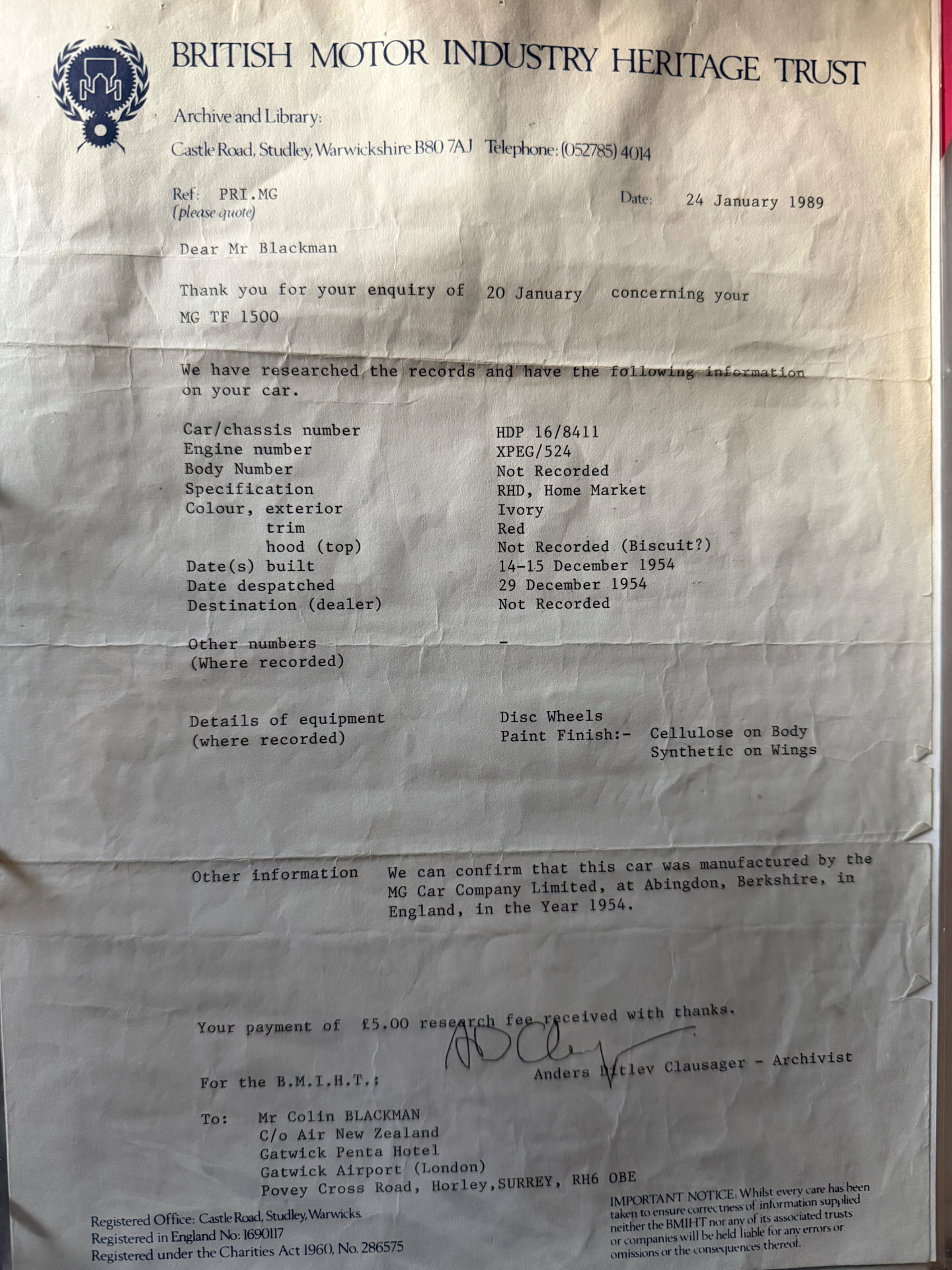
“Matching numbers” means the engine (and ideally body) numbers on the car match those the factory recorded against its chassis number when it was built. The arbiter is the British Motor Industry Heritage Trust (BMIHT) Heritage Certificate, produced from the original Abingdon build records held at the British Motor Museum. For a given chassis it states the build date, the original engine number, the original colour and trim, and the date the car left the factory. For a TF1500 it is the single most valuable document an owner can hold, it turns “it looks original” into “it is documented as original”. (The MG Car Club T Register can also supply a copy of the factory production record for a car's date.) Obtaining a Heritage Certificate for a T-type you own, or asking to see one before you buy, is the first and best step in verifying originality.
A documented example: WSU 141
The clearest way to show what a genuine, original TF1500 looks like, on paper and in the metal, is to document one. WSU 141 is a home-market, right-hand-drive TF1500 built at Abingdon on 14–15 December 1954, one of the earliest 1500s according to the club, finished in Ivory over red, and still carrying its original, factory-supplied XPEG engine. Its history is documented from new: a UK car from new, built for the home market rather than for export (its body number carries the HDP16 prefix, where the New Zealand export 1500s carried HDP26), restored in 1989 (when its BMIHT Heritage Certificate was obtained and it was re-registered WSU 141), and maintained continuously since.
Because it is a matching-numbers, Heritage-certified car, it serves as a useful reference for what to look for.
- Car number
- HDP 16/8411, stamped on the left-hand dumb-iron and recorded on the Heritage Certificate.
- Engine number
- XPEG/524, the original unit, on its octagonal plate on the offside of the block.
- Body number
- Not recorded on the Heritage Certificate.
- Colours and trim
- Ivory coachwork over red, as recorded and as it presents today.
- Documentation
- The BMIHT Heritage Certificate and the factory build details.
Owner photograph to follow
Owner photograph to follow
Owner photograph to follow
Owner photograph to follow
Originality and honest, documented change
Originality does not mean a car must be frozen exactly as it left Abingdon; it means knowing, and being able to prove, what is original and what has been changed. A car that has been sympathetically improved, with the work documented and the original parts kept, loses nothing and often gains: the change is honest, reversible and recorded. WSU 141, for instance, retains its original engine and colours but was fitted with a five-speed gearbox and an unleaded cylinder-head conversion by marque specialists Brown & Gammons in 2003, modern, usable improvements, fully invoiced, that leave the car's identity and original engine intact. That is the distinction that matters: a documented, matching-numbers car with recorded, sympathetic changes is a known quantity, which is exactly what makes it valuable, and what makes its history worth trusting.
Read next
This guide is a general introduction and is not a substitute for the official Workshop Manual for your car.