1936–1939
MG TA
MG's first Midget with a pushrod engine.
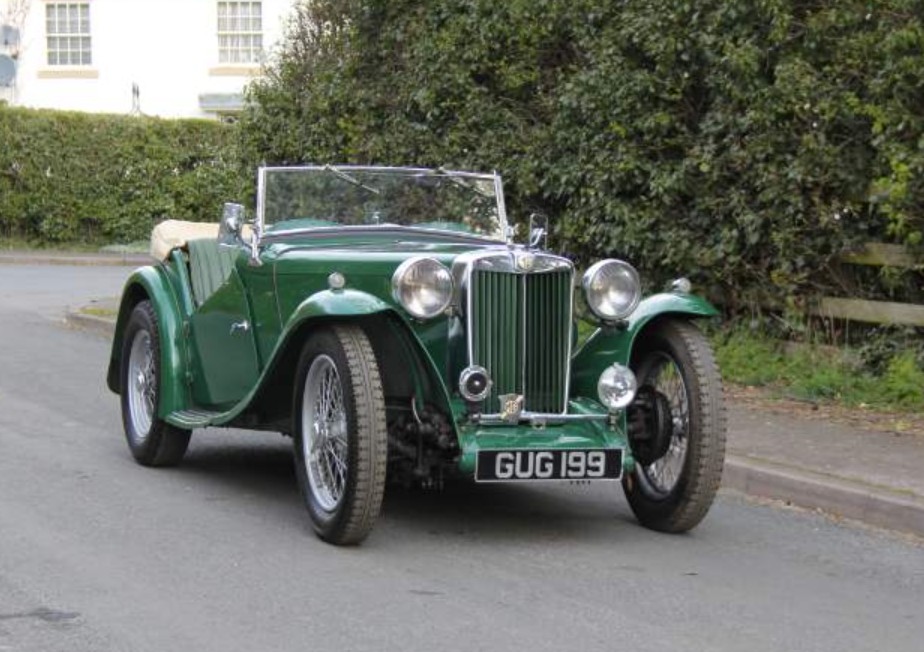
The MG TA of 1936–1939 was the first of the T-Series Midgets, powered by the 1,292 cc pushrod MPJG engine borrowed from the Wolseley 10 and producing roughly 50 bhp. Around 3,003 were built, distinguished by an oil-immersed cork clutch and a wider, softer body than the P-Type it replaced.
- Years
- 1936–1939
- Engine
- MPJG
- Capacity
- 1,292 cc
- Power
- ≈50 bhp
- Approximate built
- ≈3,003
To place a particular car, see how to read its chassis and engine numbers.
Every T-Type body tub is built on wood, so the condition of the ash frame matters more than almost anything else.
The first of the T-Series
The TA arrived in 1936 as the first car of the T-Series, built at Abingdon-on-Thames and replacing the P-Type Midget. It was a deliberate move away from the delicate overhead-cam engines of the earlier cars: a wider chassis, a more comfortable cockpit and a cheaper pushrod engine broadened the appeal of the Midget without abandoning its sporting character. Production ran to 1939, with around 3,003 cars built in all.
From overhead camshaft to pushrod, and why it mattered
The P-Type and its predecessors used overhead-camshaft engines, highly strung, expensive to build and, by the mid-1930s, out of step with the Nuffield organisation's push toward shared components. The TA's pushrod engine was the visible face of that rationalisation, and it was unpopular with purists at the time, who wanted the old overhead-cam units back. The commercial answer was clear enough: the TA was quicker than the PB it replaced and it outsold the whole P-Series. What the change really bought was an MG that ordinary owners could run and maintain, which is the thread that runs on through every later T-Type.
The MPJG engine
The 1,292 cc MPJG came from the Wolseley 10 and produced around 50 bhp. It is larger in capacity than the 1,250 cc XPAG that followed and slightly less powerful, and it shares essentially nothing with it. Sturdier and less highly strung than the P-Type units, it made the TA an easier car to live with, if less thrilling on paper. It is not an engine that rewards revving, and owners have long described it as close to untunable, which is why the XPAG's famous flexibility is not part of the TA's inheritance. Some TAs have been re-engined with later XPAG or XPEG units over the years, so the prefix stamped on the block is worth reading before paying for originality.
The oil-immersed cork clutch
The TA is distinguished mechanically by its oil-immersed cork clutch, smooth in use when correctly set up, and idiosyncratic in every other respect. It is peculiar to the TA: the TB replaced it with a conventional dry-plate unit. Along with the MPJG engine prefix it is the quickest way to tell a TA from the XPAG cars that followed.
Chassis, brakes, wheels and body
Beneath the body is the traditional pre-war layout: a beam front axle on semi-elliptic leaf springs, a live rear axle on semi-elliptic springs, cam steering practice of the period, and centre-lock wire wheels. Nothing of the independent front suspension or rack-and-pinion steering of the later TD is present, and nor should it be. The body is a steel-panelled tub over an ash frame, as on every T-Type, and its timber and the steel-to-timber joints are where money is lost on a restoration, so the body structure matters more than the engine when judging a car. Braking practice of this period is not that of the later cars, and specific brake dimensions are not stated here because no figure for the TA could be traced to a named source. Take them from the Workshop Manual for your own car.
Bodies: open two-seater and Tickford
The open two-seater is the familiar TA, and it is not the only one. Tickford drophead coupé coachwork, with wind-up windows and a folding hood, was available alongside it during TA production, giving a genuinely all-weather MG. A Tickford is a rarer car than an open TA, and the coachwork is its own restoration project.
Competition, and the Cream Crackers
The TA carries a competition history the later road cars cannot claim. It is the car of the Cream Cracker trials teams, and that association is a real part of why a TA is wanted today. The site's competition history page covers the wider picture of MG in period trials and racing.
Numbers, colours and what can be checked
Chassis numbers carry a TA prefix and engine numbers an MPJG prefix. Beyond that, the honest position is that no chassis band defines a given model year: MG published no yearly production split for the TA, so a car's build date is established from the MG Car Club T Register's factory production record and from its BMIHT Heritage Certificate, not from its number. The same applies to colours and trim. The TA was offered in a range of factory combinations, and no list is asserted here because the authority for a particular car is its own certificate. Body numbering practice for the TA is not set out here either, because no scheme could be verified to a named authority; the T Register's registrar is the person to ask.
The TB, and how few TAs remain
The TB replaced the TA in the spring of 1939 and brought the changes that shaped every later T-Type: the 1,250 cc XPAG engine at 54 bhp, a conventional dry-plate clutch and revised gearing. Just 379 TBs were built before Abingdon turned to aircraft components and tank modification, which makes 1939 the year the T-Series changed direction entirely. As to how many TAs survive, no verified survivor figure is published here. Around 3,003 were built, most of them ninety years ago, and many have since been re-engined or lost; the T Register's records and its registrar are the only sound basis for a survival estimate, and the register is where an owner should begin.
Full reference
MG TA specification and identification
What can honestly be established about the MG TA in one place: the specification that is documented, chassis and engine number practice, production figures, the checks that matter on a viewing, and current value bands. Where a figure could not be traced to a named source it is left out rather than guessed at.
Factory specification
Engine
| Type | MPJG, four cylinders in line, pushrod overhead valve |
|---|---|
| Capacity | 1,292 cc |
| Origin | Derived from the Wolseley 10 unit |
| Power | Around 50 bhp |
| Bore, stroke, compression and torque | Not quoted here: no named source for the MPJG's internal figures could be confirmed. Take them from the Workshop Manual for your car |
Transmission
| Clutch | Oil-immersed cork clutch, peculiar to the TA and replaced by a conventional dry plate on the TB |
|---|---|
| Gearbox | Four speed. Early cars have synchromesh on the top two gears only, and no T-Type has synchromesh on first |
| Ratios and final drive | Not stated here: no factory ratio table for the TA could be traced. The T Register and the Workshop Manual are the sources to use |
Chassis and brakes
| Chassis | Separate chassis with an ash-framed, steel-panelled body tub |
|---|---|
| Front suspension | Beam front axle on semi-elliptic leaf springs. No independent front suspension, which arrived with the TD |
| Rear suspension | Live axle on semi-elliptic leaf springs |
| Steering | Cam steering box of the period. Rack and pinion did not arrive until the TD |
| Brakes | Drum brakes of the period. No dimension is given here because no TA brake figure could be traced to a named source |
| Wheels | Centre-lock wire wheels. No verified rim or tyre size is published here |
Dimensions, weight and capacities
| All figures | Deliberately not quoted. Wheelbase, track, overall dimensions, weight and oil, coolant and fuel capacities for the TA could not be confirmed against a named source, so they are omitted rather than invented |
|---|
No performance figures are stated here. Around 50 bhp is documented, and the TA was quicker than the PB it replaced, with 80 mph quoted with the windscreen folded, yet no dated period road test could be cited for a top speed or an acceleration time. The original test report, or Clausager, which reproduces period data with issue dates, is the source worth trusting.
Sources for these figures
- MG Car Club T Register, chassis and engine prefixes and the T Type Factory Production Records.
- Anders Clausager, “Original MG T Series”, production total and production dates.
- The absence of dimensional, capacity and performance figures above is deliberate: they could not be traced to a factory data sheet or a dated period test.
Chassis and engine number identification
Chassis numbers
TA chassis numbers carry a TA prefix. No published chassis band defines a given model year, because MG published no yearly production split for the TA, so a car's build date is established from the factory record rather than from its number.
Engine numbers and prefixes
TA engines carry an MPJG prefix. An XPAG or XPEG block in a TA is a later replacement, extremely common after ninety years, and it does not make the car a TB. Read the prefix on the block before paying for originality.
Body numbering
No body-number scheme is asserted here, because none could be verified to a named authority for the TA. Anyone chasing a body number should ask the MG Car Club T Register's registrar rather than trust a figure found online.
Confirming a car against the factory record
The T Register holds the searchable T Type Factory Production Records, and a car's BMIHT Heritage Certificate records its original colour, trim and despatch date. Treat any claim of matching numbers, or of an original colour, as unproven until it agrees with those.
Full number formats for every T-Type are set out in Chassis & Engine Number Identification, and the lookup procedure in Production Records.
Production figures
| Total built | Around 3,003 |
|---|---|
| Production years | 1936–1939 |
| Chassis prefix | TA |
| Engine prefix | MPJG |
| Built at | Abingdon-on-Thames, Oxfordshire |
MG published no per-year breakdown of TA production, so no yearly figures are given here. Nor is a survivor figure: no verified count of surviving TAs is published, and the T Register's records are the only sound basis for an estimate. A car's own despatch date comes from the factory record.
What to check on a MG TA
Ash frame and body tub
The timber frame and the steel-to-timber joints are where money is lost on a TA. Press around the A and B posts, the door bottoms, the rear wings and the floor edges for softness, and be suspicious of fresh paint over panels that move.
Engine prefix against the claim
Check for the MPJG prefix on the block. Many TAs now carry later XPAG or XPEG units, which is a disclosure and value question rather than a mechanical disaster, and it changes the character of the car considerably.
How the engine has been used
The MPJG is not a revver, and an over-revved MPJG is a ruined MPJG. Ask how the car has been driven and maintained, and treat any claim of tuning work with caution: this is not the tunable XPAG of the later cars.
Clutch behaviour
The oil-immersed cork clutch is smooth when correctly set up and awkward when it is not. Judder, drag or a clutch that will not free after standing all point at setting up and condition rather than at anything exotic.
Front axle, kingpins and steering
The beam axle and cam steering box need regular greasing and adjustment. Wandering steering, play at the kingpins or a dry, seized nipple tell you how the car has been kept more honestly than any invoice.
MG TA parts supply and running costs
The MPJG's isolation is the real ownership issue
Because the MPJG shares essentially nothing with the XPAG family, the TA cannot draw on the deep parts supply that supports the TC, TD and TF. Engine parts in particular are a specialist and often remanufactured proposition, so allow for lead times and for patience.
Body, timber and trim
Timber, coachwork and chrome dominate TA bills, as they do on every T-Type, and Tickford drophead coachwork is its own project again. No prices are published here because they move too quickly to be useful; get current quotations from two specialists before budgeting.
Where to ask
The MG Car Club T Register and the specialists listed in our directory are the practical starting points for TA spares. The TA is rare outside the UK, so overseas owners should expect to source from Britain.
Current suppliers and restorers are listed in the Specialists directory, and cars currently offered for sale in On the Market.
What a MG TA is worth
| Project | Good | Excellent | Concours |
|---|---|---|---|
| £8,000–£12,000* | ≈£15,000 (fair) | ≈£35,900 | ≈£51,400 |
Source: Hagerty UK Valuation Tool (published 2022) (2022). Indicative ranges, not valuations, see the Values & Price Guide for condition definitions and caveats.
Common MG TA questions
- What engine does the MG TA have?
- The MG TA uses the 1,292 cc MPJG four-cylinder pushrod overhead-valve engine derived from the Wolseley 10, producing around 50 bhp. It is larger in capacity than the 1,250 cc XPAG that followed, slightly less powerful, and shares essentially nothing with it.
- How many MG TAs were built?
- Around 3,003 MG TAs were built at Abingdon between 1936 and 1939. MG published no per-year split, so a particular car's build date comes from the MG Car Club T Register production record rather than from its chassis number.
- Was the MG TA the first T-Series MG?
- Yes. The TA of 1936 was the first of the T-Series Midgets, replacing the overhead-cam P-Type with a wider chassis, a more comfortable cockpit and the pushrod MPJG engine.
- Why did MG move from an overhead camshaft to a pushrod engine?
- The overhead-cam engines of the P-Type and its predecessors were highly strung and expensive to build, and the Nuffield organisation was pushing toward shared components. The pushrod MPJG was the result. Purists disliked it at the time, yet the TA was quicker than the PB it replaced and outsold the whole P-Series.
- How do I tell an MG TA from a TB?
- By the engine and clutch. A TA carries the 1,292 cc MPJG with an oil-immersed cork clutch; the TB, introduced in spring 1939, uses the 1,250 cc XPAG at 54 bhp with a conventional dry-plate clutch. Many TAs now carry XPAG engines, so check the chassis prefix and the factory record rather than the block alone.
- Can the MG TA's MPJG engine be tuned?
- Not usefully. The MPJG is not a revver and owners have long described it as close to untunable, which is why the XPAG's famous flexibility is not part of the TA's inheritance. Some TAs have been re-engined with later XPAG or XPEG units instead, which must be disclosed and affects both value and character.
- How many MG TAs survive?
- No verified survivor figure is published here. Around 3,003 were built, most of them ninety years ago, and many have since been re-engined or lost. The MG Car Club T Register's records and its registrar are the only sound basis for a survival estimate.
- Was a closed MG TA available?
- Yes. Tickford drophead coupé coachwork, with wind-up windows and a folding hood, was offered alongside the open two-seater during TA production. A Tickford is the rarer car, and its coachwork is a restoration project in its own right.
- Does the MG TA have wire wheels?
- Yes, centre-lock wire wheels, as on the TB and TC. Bolt-on pressed-steel disc wheels arrived with the TD, which never offered wires at all.
- What colours was the MG TA available in?
- The TA was offered in a range of factory colours and trims, but the only reliable answer for a particular car is its own record. The original body colour and trim are recorded on the car's BMIHT Heritage Certificate and in the T Register production records, so those, rather than any published list, are the authority.
- Where were MG TAs built?
- Every MG TA was built at the Abingdon-on-Thames works in Oxfordshire, MG's home from 1929 until the plant closed in 1980.
- Is the MG TA a good first classic?
- It is a harder proposition than a TD. The MPJG shares little with the XPAG family, so parts supply is thinner, and the beam axle, cam steering and pre-war character ask more of the driver. Buy a TA for its history and its trials heritage rather than for ease of ownership.