1950–1953
MG TD
Independent front suspension, and 29,664 built.
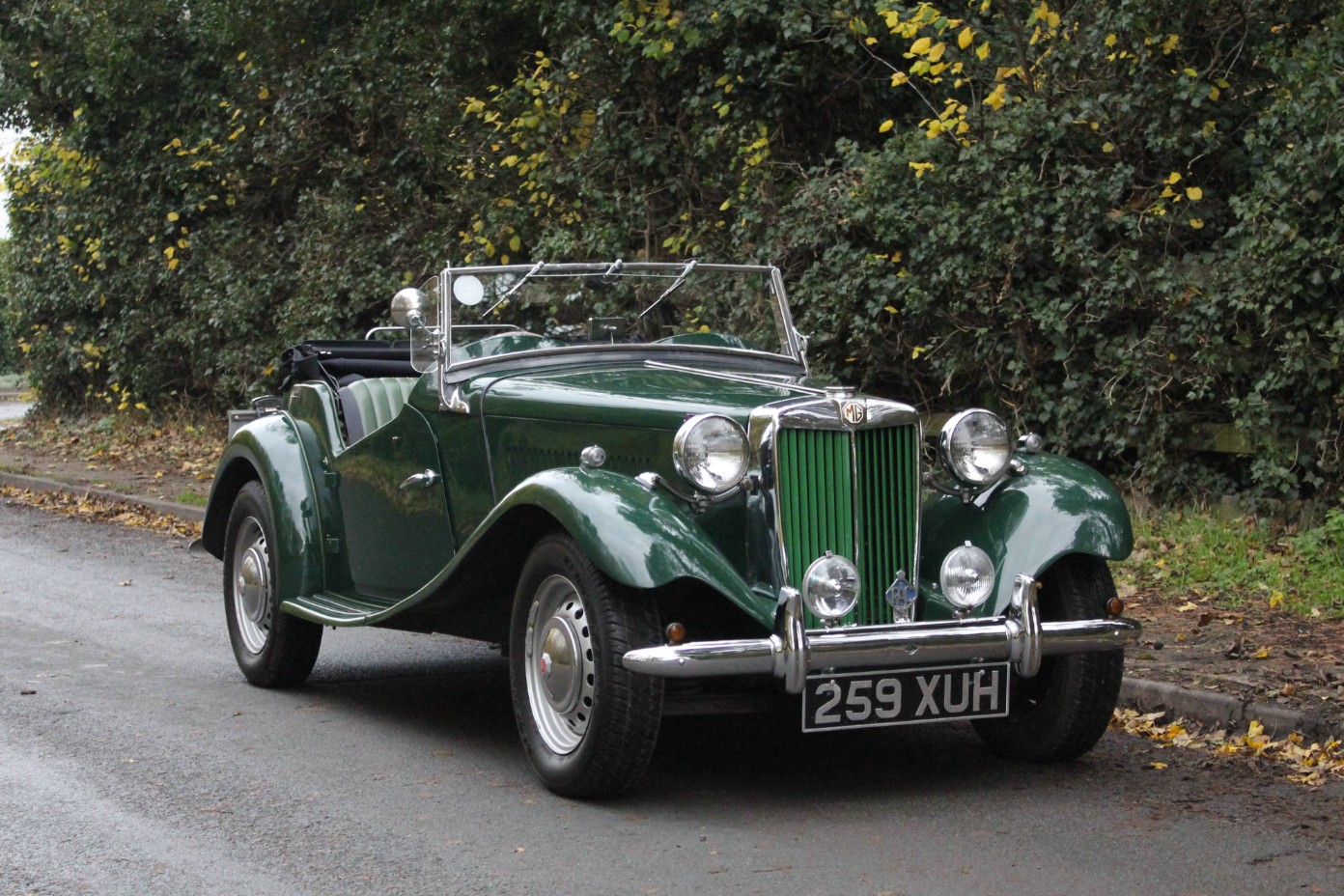
The MG TD of 1950–1953 was the best-selling T-Type, with roughly 29,664 built. It kept the 1,250 cc XPAG engine but wrapped it in a substantially modernised chassis with independent front suspension, rack-and-pinion steering and factory left-hand drive, the T-Series built, at last, for a worldwide market.
- Years
- 1950–1953
- Engine
- XPAG
- Capacity
- 1,250 cc
- Power
- 54 bhp
- Approximate built
- ≈29,664
For the story of the engine itself, its Morris origins, specifications, the enlarged XPEG and its known weak spots, see the XPAG engine hub.
To place a particular car, see how to read its chassis and engine numbers.
Every T-Type body tub is built on wood, so the condition of the ash frame matters more than almost anything else.
A significant modernisation
Beneath a body that still looked unmistakably T-Type, the TD introduced a new box-section chassis with independent front suspension and rack-and-pinion steering, both a decisive improvement over the beam axle of the earlier cars. The frame was derived from the Y-type saloon, the track was wider than the TC's, the rear axle was a hypoid unit, and the front brakes were of twin-leading-shoe design. None of it made the car dramatically faster. All of it made the car ride, steer and stop in a way a TC never had, which is why the TD is the T-Type most people find they can actually use on modern roads.
Disc wheels, not wire
The TD left Abingdon on 15-inch bolt-on pressed-steel disc wheels with octagon-centred hub caps, in place of the centre-lock wire wheels of the TA to TC. Wire wheels were not a TD option at all; they returned to the range only with the TF. This is the most commonly altered thing on a surviving TD, because many owners have fitted wires for the look, so a TD on wire wheels is a modified car rather than a wrong one. For strict originality it is the disc wheels, their hub caps and the tyre type that are checked first.
The body, and the bumpers
The body tub is a steel-panelled shell over an ash frame, as on every T-Type, and its timber is the single most expensive thing to get wrong on a restoration. Externally the clearest break from the TC is that the TD carried chromed bumpers with overriders front and rear as standard equipment, where the TC had none. The dashboard was laid out symmetrically with the instruments grouped centrally, an arrangement that allowed one dash to serve both left- and right-hand-drive cars, and the seat back was a bench-style unit; the individual seat backs many people associate with the T-Series arrived with the TF.
XPAG, familiar and modestly changed
The 1,250 cc XPAG continued essentially as in the TC, with twin SU carburettors and around 54 bhp, so outright performance barely moved. Two changes matter to an owner. From the middle of 1951, at around engine 9408, a new block, sump, bell-housing and flywheel were adopted to take a larger eight-inch clutch, and the engine prefix became XPAG/TD2. During TD production the XPAG also changed internally from the early banana block and head to the later round-water-passage type. Neither change is visible from the driving seat, and both matter a great deal when ordering parts.
The Mark II, and the TD2 it is not
Separately, from the middle of 1950, MG built a higher-performance car alongside the standard TD: the Mark II, carried in the records under the TD/C prefix and sometimes called the Competition Model. It ran a more highly tuned XPAG with raised compression and larger carburettors, twin fuel pumps, revised dampers and a higher axle ratio, and around 1,710 were built. The confusion to avoid is this: TD2 is only an engine designation applied to the ordinary car after the 1951 clutch change, while the Mark II is a distinct higher-specification model. Later Mark IIs wore identifying badges on the bonnet sides and rear bumper, earlier ones before TD/C 22613 did not, which is why badges settle nothing. The engine specification and the factory production record are what settle it, and a Mark II premium should be supported by that record rather than by a seller's description.
Built for the world
For the first time, MG offered left-hand drive from the factory, with left-hand-drive engine numbers prefixed LHX. Combined with the modernised chassis, this made the TD an easy sell in the United States and mainland Europe, and it went on to be by far the best-selling T-Type at roughly 29,664 cars, the overwhelming majority exported, more than twenty-three thousand of them to the United States alone. The consequence for an owner today is a happy one: the TD has the strongest parts supply and the largest owner community of any T-Type, on both sides of the Atlantic.
Colours, trim and the record
The TD was offered in a range of factory colours and trim combinations, and the correct one for a particular car is a matter of record rather than taste. No list is published here, because the authority for a given car is its own BMIHT Heritage Certificate, which records the original body colour, trim and despatch date, cross-checked against the T Register's production records. A repaint in a colour the car never wore is a departure from originality, so the certificate is the place to start rather than the colour the car happens to wear now.
Numbers, and what can honestly be checked
The car number is stamped on a plate on the bulkhead and the engine number on the block, and both are set out with their prefixes in the identification section below. Body and tub numbering is a different matter: the TD was among the last cars built under Nuffield before the merger into BMC, individual-car records from that period are less complete than for the TF, and no body-number scheme is asserted here because none can be verified to a named authority. Anyone chasing a body number should ask the T Register's registrar rather than trust a figure found online.
Between the TC and the TF
Placed either side, the TD is the pivot of the range. Against the TC it gives up centre-lock wire wheels and a certain vintage directness, gaining independent front suspension, rack-and-pinion steering, standard bumpers, a hypoid axle and factory left-hand drive. Against the TF it gives up the faired-in headlamps, the sloping grille and, on the last cars, the larger 1,466 cc XPEG engine, while remaining much the commoner and better-supported car: production ended in August 1953 after roughly 29,664 cars, where all TF variants together account for about 9,600. The TF was in essence a facelifted TD Mark II, which is the clearest statement of how much the TD underpinned what followed.
Full reference
MG TD specification and identification
Everything needed to identify, evaluate and understand an MG TD in one place: factory specification, chassis and engine number practice, production figures, the checks that matter on a viewing, and current value bands.
Factory specification
Engine
| Type | XPAG, four cylinders in line, overhead valve, three main bearings |
|---|---|
| Capacity | 1,250 cc |
| Bore × stroke | 66.5 mm × 90 mm (2.618 in × 3.543 in) |
| Compression ratio | 7.25:1 (standard TD) |
| Power | 54.4 bhp at 5,200 rpm |
| Torque | 63.5–64 lb ft at 2,600 rpm |
| Carburettors | Twin SU; larger 1½ in instruments on the Mark II |
Transmission
| Gearbox | Four speed, synchromesh on second, third and top |
|---|---|
| Ratios | Top 1.00, third 1.385, second 2.07, first 3.50, reverse 3.50 |
| Final drive | 5.125:1 standard (41/8); 4.875:1 (39/8, standard on the Mark II) and 4.55:1 (9/41) also offered |
| Clutch | Dry plate, 7 in on early cars, 8 in from the TD2 engine change |
Chassis and brakes
| Chassis | Separate box-section frame, ash-framed body tub |
|---|---|
| Front suspension | Independent, coil spring and wishbone (Y-Type derived) |
| Rear suspension | Live axle on semi-elliptic leaf springs |
| Steering | Rack and pinion |
| Brakes | Lockheed hydraulic, two-leading-shoe drums front and rear, 9 in diameter |
| Wheels and tyres | Bolt-on 15 in disc wheels, 5.50–15 tyres at 18 lb/sq in |
Dimensions and weight
| Wheelbase | 94 in (7 ft 10 in / 2,388 mm) |
|---|---|
| Track, front | 47.5 in (1,203 mm) |
| Track, rear | 50 in (1,270 mm) |
| Overall length | 145 in (3,683 mm) |
| Overall width | 58.5 in (1,489 mm) |
| Overall height | 53 in (1,346 mm), hood up |
| Ground clearance | 6 in |
| Weight | Disputed. The TD Workshop Manual General Data, as cited below, gives 18.5 cwt, 2,072 lb (941 kg). Barrie Jones gives 18 cwt (914 kg) for the TD and 18.5 cwt for the TF. The two may be quoting different bases, dry against unladen, and the archive has not established which. Both are given rather than one chosen. |
Capacities
| Fuel tank | 12.5 imperial gallons (15 US gal, 57 litres) |
|---|---|
| Engine oil | 9 pints (5.1 litres) up to engine no. 14948; 10.5 pints (5.96 litres) thereafter |
| Gearbox oil | 1.25 pints (0.71 litres) |
| Rear axle oil | 2.25 pints (1.3 litres) |
| Cooling system | 12 pints (6.8 litres) |
| Brake fluid | 1 pint (0.57 litres) |
Period road tests are the honest source on performance. The Autocar tested the TD in its issue of 20 January 1950 and recorded a genuine top speed of over 80 mph. Widely repeated 0–60 mph times circulate online without a cited test behind them, so no acceleration figure is given here, check the full Autocar test or the Workshop Manual rather than an aggregator.
Sources for these figures
- M.G. Midget Series “TD” Workshop Manual, Issue 3 (Export), 78690–1/53, General Data, as reproduced by the MG Car Club (mg-cars.org.uk).
- Final-drive alternatives cross-checked against the MG Car Club Y Register XPAG data pages.
- Production totals: Anders Clausager, “Original MG T Series”, via mg-cars.org.uk; total cross-checked with the MG Owners’ Club MG TD guide.
- Barrie Jones, MG TD, TF & TF1500: 1949–1955, The Essential Buyer's Guide, Veloce Publishing, ISBN 978-1-845843-52-6, pages 56 to 58: chassis and engine number locations and ranges, thread practice, and the TD weight of 18 cwt that disagrees with the Workshop Manual figure above.
Chassis and engine number identification
Chassis numbers
TD car numbers run from 0251 to 29915, with the earliest numbers used by prototypes and production proper beginning at the end of 1949. The number is stamped into the front left chassis dumb-iron, where the front wing hides it, and it appears again on the car's identity plate. Sources describe that plate differently: this archive's own identification page places the guarantee plate on the bulkhead, while Barrie Jones describes a brass identity plate attached to the toolbox. They are most likely the same plate, and the archive has not established which description is the more exact. A plate renewed during restoration is common enough, but the number should still agree with the factory record and with the stamping on the dumb-iron.
Engine numbers and prefixes
Early TD engines are numbered XPAG/TD/501 to XPAG/TD/9407. From July 1951 the prefix changes to XPAG/TD2, beginning at engine 9408, when the larger eight-inch clutch was adopted. From June 1952 Competition Model engines were designated XPAG/TD3, but that code was not applied to earlier Competition cars, so an early Mark II will not carry it and its absence proves nothing on its own. Left-hand-drive engine numbers are prefixed LHX. TD/C, the Mark II, with larger valves and carburettors and stiffer front suspension, is routinely and wrongly confused with TD2, which is only an engine designation. In the XPAG code, X is the engine series, P pushrod, A the 66.5 mm bore and G for MG; the E of XPEG denotes its 72 mm bore.
Confirming a car against the factory record
The MG Car Club T Register holds the searchable factory production records, and is the authoritative check on chassis number, engine number, original colour and despatch date. Treat a seller's claim of matching numbers as unproven until it agrees with that record.
Full number formats for every T-Type are set out in Chassis & Engine Number Identification, and the lookup procedure in Production Records.
Production figures
| Total built | 29,664 |
|---|---|
| Car number range | 0251 – 29915 |
| Mark II (TD/C) built | At least 1,710 (Clausager) |
| Production years | 1950 – 1953 |
| Built at | Abingdon-on-Thames, Oxfordshire |
The car number range is wider than the production total because numbers were not used consecutively without gaps. The Mark II figure is Clausager's published minimum rather than an exact factory count.
What to check on a MG TD
Chassis cracks below the rear spring hangers
The TD-specific weak point. Look underneath at the frame immediately below the rear spring mountings, where cracking is well documented and expensive to put right properly.
Ash frame and body tub
The body is timber-framed. Press around the A and B posts, the door bottoms and the rear wings for softness, steel panels can hide a rotten frame beneath fresh paint.
Engine number against the claim
Check the XPAG prefix matches what the seller says the car is. A TD2 engine does not make a car a Mark II, and a Mark II premium should be supported by the factory record.
Steering, kingpins and dampers
The Y-Type-derived front end needs regular greasing. Wandering steering, play at the kingpins or weeping dampers are all cheap to put right but tell you how the car has been kept.
What a MG TD is worth
| Project | Good | Excellent | Concours |
|---|---|---|---|
| ≈£10,500 (needy) | £15,000–£22,000* | £25,000–£30,000* | ≈£35,200 (perfect) |
Source: Hagerty UK Valuation Tool (published 2022) (2022). Indicative ranges, not valuations, see the Values & Price Guide for condition definitions and caveats.
Common MG TD questions
- What engine does the MG TD have?
- The MG TD uses the 1,250 cc XPAG four-cylinder overhead-valve engine with twin SU carburettors, 66.5 mm bore and 90 mm stroke, a 7.25:1 compression ratio and 54.4 bhp at 5,200 rpm.
- How many MG TDs were built?
- Around 29,664 MG TDs were built between 1950 and 1953, making it by far the best-selling T-Type. Car numbers run from 0251 to 29915, and at least 1,710 were Mark II (TD/C) cars.
- What is the difference between a TD Mark II and a TD2?
- The Mark II, factory designation TD/C, is a higher-specification car with larger valves and carburettors and stiffer front suspension. TD2 is only an engine designation, adopted from around engine 9408 in mid-1951 with the larger eight-inch clutch. A TD2 engine does not make a car a Mark II.
- Where is the chassis number on an MG TD?
- The car number appears on a plate on the bulkhead, and the engine number is stamped on the block with an XPAG/TD, XPAG/TD2 or XPAG/TD3 prefix. Both should be checked against the MG Car Club T Register factory production records.
- How much is an MG TD worth?
- Indicative UK figures put a project MG TD at around £10,500, a good usable car at roughly £15,000–£22,000, an excellent car at £25,000–£30,000 and a perfect example near £35,200. Values move, so treat these as ranges rather than valuations.
- Is the MG TD a good first classic?
- It is the best-supported T-Type. Parts availability is the strongest of the range, the independent front suspension and rack-and-pinion steering make it easier to drive than a TC, and factory left-hand drive means good supply in the United States as well as the UK.
- How fast is an MG TD?
- The Autocar's road test of 20 January 1950 recorded a genuine top speed of over 80 mph. Acceleration figures quoted online usually lack a cited source, so the period test itself is the figure worth trusting.
- Did the MG TD have wire wheels?
- No. The TD was built on 15-inch bolt-on pressed-steel disc wheels with octagon-centred hub caps, and wire wheels were not a factory option on it at any point. Wire wheels returned to the range with the TF. A TD wearing wires has been modified, which is common and reversible, but it is not original.
- How does the MG TD differ from the TC?
- The TD replaced the TC's beam front axle with independent coil and wishbone suspension, added rack-and-pinion steering on a wider chassis derived from the Y-type saloon, fitted a hypoid rear axle and twin-leading-shoe front brakes, changed from centre-lock wire wheels to bolt-on disc wheels, added chromed bumpers as standard, and offered left-hand drive from the factory. The 1,250 cc XPAG engine carried over largely unchanged.
- How does the MG TD differ from the TF?
- The TF, launched on 15 October 1953, was in essence a facelifted TD Mark II: the same basic chassis, restyled with headlamps faired into the wings and a sloping radiator grille, and using the Mark II engine. The last TFs gained the larger 1,466 cc XPEG engine. The TD is much the commoner car, at roughly 29,664 against about 9,600 TFs of all variants.
- Was the MG TD available in left-hand drive?
- Yes. The TD was the first T-Type offered in left-hand drive from the factory, with left-hand-drive engine numbers prefixed LHX. The great majority of TDs were exported, more than twenty-three thousand of them to the United States, which is why the American parts and club network for the model is so strong.
- What colours was the MG TD available in?
- The TD was offered in a range of factory colours and trim combinations, but the only reliable answer for a particular car is its own record. The original body colour and trim are recorded on the car's BMIHT Heritage Certificate and in the MG Car Club T Register production records, so those, rather than any published list, are the authority.
- Where were MG TDs built?
- Every MG TD was built at the Abingdon-on-Thames works in Oxfordshire, MG's home from 1929 until the plant closed in 1980.