1953–1955
MG TF
The final front-engined MG Midget, 1953 to 1955.
This page covers the classic MG TF of 1953 to 1955. For the mid-engined MG TF of 2002 to 2011, see MG TF: classic or modern?
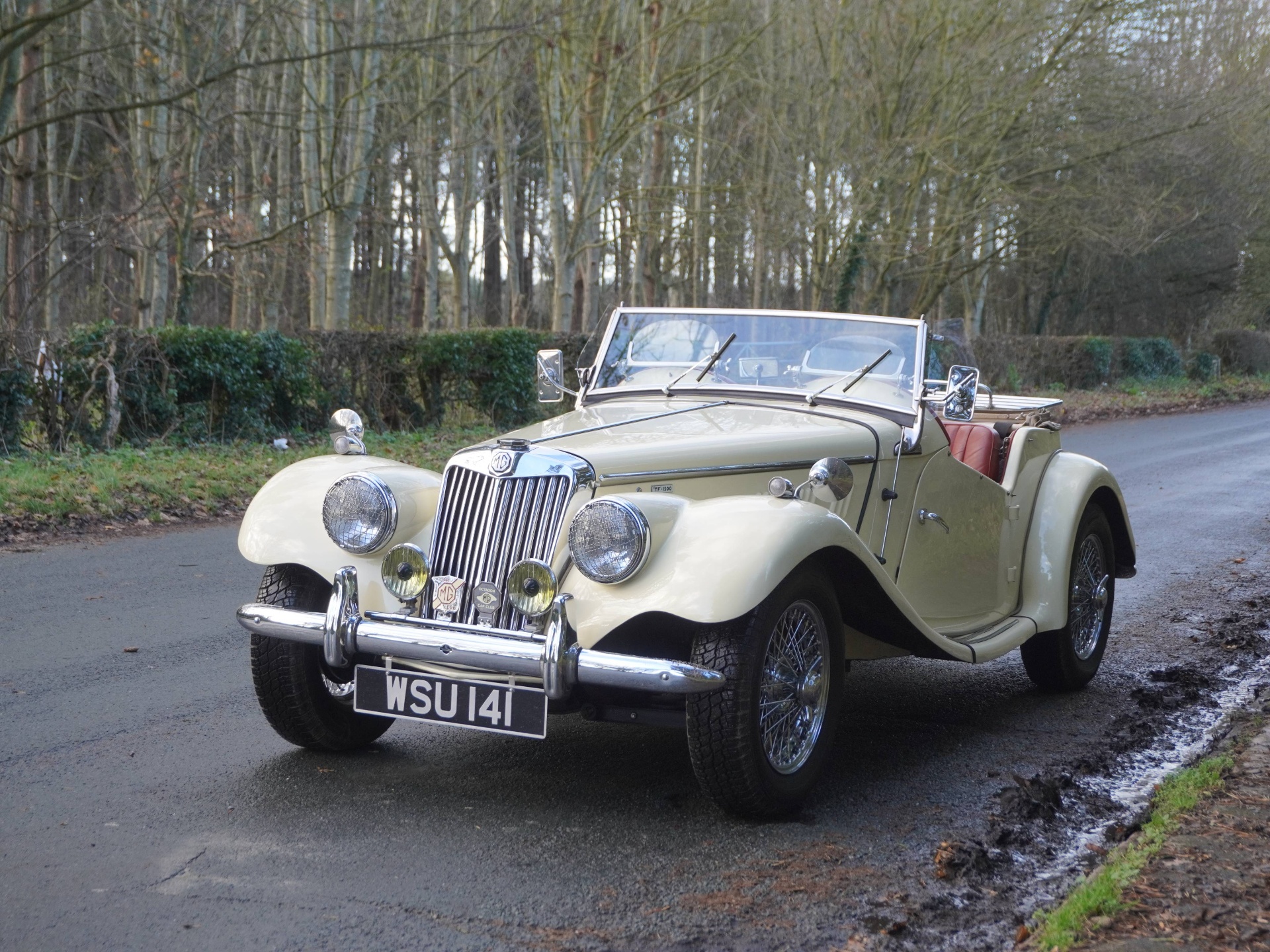
The MG TF of 1953–1955, the front-engined Midget built at Abingdon rather than the mid-engined Rover-era roadster of 2002–2011, was launched on 15 October 1953. It was a facelifted TD with headlamps faired into the wings, a sloping radiator grille concealing a separate radiator, and pressurised cooling with a simulated external filler cap. It used the TD Mark II engine, XPAG at 8:1 compression, twin carburettors, 57.5 bhp at 5,500 rpm. From 1954 the larger 1,466 cc XPEG engine turned it into the TF 1500.
- Years
- 1953–1955
- Engine
- XPAG (later XPEG)
- Capacity
- 1,250 cc (later 1,466 cc)
- Power
- 57.5 bhp @ 5,500 rpm
- Approximate built
- ≈9,600 (all TF variants)
For the story of the engine itself, its Morris origins, specifications, the enlarged XPEG and its known weak spots, see the XPAG engine hub.
To place a particular car, see how to read its chassis and engine numbers.
Every T-Type body tub is built on wood, so the condition of the ash frame matters more than almost anything else.
A facelifted TD
Launched on 15 October 1953, the TF kept the TD chassis but restyled the front: headlamps faired into the wings, a sloping radiator grille concealing a separate radiator, and pressurised cooling with a decorative external filler cap for looks rather than function.
The TD Mark II engine
The TF's XPAG was in TD Mark II tune: compression raised to 8:1, larger inlet and exhaust valves, stronger valve springs and twin carburettors, producing 57.5 bhp at 5,500 rpm.
TF 1500
From 1954, the TF gained a larger 1,466 cc XPEG engine and became the TF 1500, giving the final T-Type the performance its more modern silhouette had always suggested. See the dedicated TF 1500 page.
The last of the traditional MGs
TF production ended in 1955 when the MGA replaced it with an entirely new car. The TF is widely regarded as the last of the traditional MGs, the closing chapter of a shape that had begun with the TA nearly two decades earlier.
Full reference
MG TF specification and identification
Everything needed to identify, evaluate and understand an MG TF in one place: factory specification for both the 1,250 cc XPAG and the later 1,466 cc XPEG cars, chassis and engine number practice, production figures, buying checks and current values.
Factory specification
Engine, XPAG/TF (1,250 cc, 1953–54)
| Type | XPAG/TF, four cylinders in line, overhead valve, three main bearings |
|---|---|
| Capacity | 1,250 cc |
| Bore × stroke | 66.5 mm × 90 mm (2.618 in × 3.543 in) |
| Compression ratio | 8.0:1, raised from the standard TD's 7.25:1 |
| Power | 57.5 bhp at 5,400 rpm, with the safe limit raised to 6,000 rpm (October 1953 factory press release; some reprints quote 5,500 rpm) |
| Carburettors | Twin SU. The factory press release says 1½ in bore; club literature usually describes the TF's instruments as SU H4, a discrepancy worth resolving against the Workshop Manual before ordering parts |
| Torque | Not given here: no factory torque figure for the TF could be confirmed |
Engine, XPEG (1,466 cc, TF 1500, 1954–55)
| Type | XPEG, the XPAG block with siamesed cylinders allowing a larger bore |
|---|---|
| Capacity | 1,466 cc |
| Bore × stroke | 72 mm × 90 mm |
| Power | 63 bhp at 5,000 rpm, about 9% more than the XPAG/TF, but torque up about 18% |
| Engine number prefix | XPEG/ only, for example XPEG/524, never XPEG/TF/; XPAG/TF numbers run in the 30,000s |
Transmission
| Gearbox | Four speed, single dry-plate clutch, direct top gear |
|---|---|
| Overall ratios | Top 4.875, third 6.725, second 10.09, first 17.06 |
| Final drive | 4.875:1, higher-geared than the standard TD, giving 15.25 mph per 1,000 rpm in top |
| Clutch diameter | Not quoted: the press release states only 'single dry plate'. Confirm against the Workshop Manual |
Chassis and brakes
| Chassis | Boxed side-member frame carried over from the TD, ash-framed body tub |
|---|---|
| Front suspension | Independent, coil springs and wishbones |
| Rear suspension | Live axle on semi-elliptic leaf springs; double-acting hydraulic lever-arm dampers all round |
| Steering | Rack and pinion, 2½ turns lock to lock, 31 ft turning circle |
| Brakes | Lockheed hydraulic drums all round, 9 in diameter, 99.5 sq in friction area |
| Wheels and tyres | Bolt-on 15 in disc wheels standard, centre-lock wire wheels an extra-cost option; 5.50–15 tyres |
Dimensions and weight
| Wheelbase | 94 in (7 ft 10 in / 2,388 mm), the TD chassis carried over unchanged |
|---|---|
| Overall length | 12 ft 3 in (147 in, 3.73 m), two inches longer than the TD (Barrie Jones). Absolute figures differ between press reprints; this is the one the archive follows. |
| Overall width | 4 ft 11¾ in (59.75 in, 1.52 m) (Barrie Jones) |
| Overall height | 4 ft 4½ in (52.5 in, 1.33 m), hood up (Barrie Jones). The October 1953 factory press release describes the TF as 1½ in lower than the TD, but Jones's hood-up figures for the two cars differ by half an inch. The disagreement is unresolved and may turn on what was being measured. |
| Weight | 17.5 cwt dry, approximately 1,960 lb (889 kg), from the October 1953 factory press release. Barrie Jones gives 18.5 cwt (939 kg), most likely an unladen rather than a dry figure. Both are given rather than one chosen. |
Capacities
| Fuel tank | 12 imperial gallons (55 litres), rear-mounted and fed by an electric pump |
|---|---|
| Engine oil | 10.5 pints (6.0 litres) (Barrie Jones) |
| Gearbox oil | 1.25 pints (0.7 litres) (Barrie Jones) |
| Rear axle oil | 2.25 pints (1.3 litres) (Barrie Jones) |
| Coolant and brake fluid | Still not quoted: no named source for the TF's cooling system or brake fluid capacity has been confirmed. Take them from the Workshop Manual for your car. |
The October 1953 factory press release claimed that a well-tuned TF should reach 6,000 rpm in top for a genuine 90 mph, a manufacturer's projection, not a measured result. No named, dated Autocar or Motor road test of the TF could be verified for this page, so no independent top speed or acceleration figure is stated. Clausager reproduces period test data with issue dates and is the source worth going to.
Sources for these figures
- MG factory press release, October 1953, as reproduced by the Australian T-Series Association, engine, transmission ratios, steering, brakes, fuel tank and dry weight.
- MG Owners’ Club MG TF 1500 guide, total production of 9,600 cars, all versions.
- Classic & Sports Car MG TF 1250 data sheet, 6,200 TF 1250s built, giving roughly 3,400 TF 1500s.
- MG Car Club T Register, chassis and engine identification and the T Type Factory Production Records.
- XPEG bore and power, and the alternating XPAG/XPEG chassis batches, as set out on this site’s TF 1500 page from club records and the period Road & Track report.
- Barrie Jones, MG TD, TF & TF1500: 1949–1955, The Essential Buyer's Guide, Veloce Publishing, ISBN 978-1-845843-52-6, pages 56 to 58: TF dimensions, capacities, chassis and engine number ranges, and the 3,400 TF 1500 figure.
Chassis and engine number identification
Chassis numbers
TF chassis numbers carry a TF prefix and are stamped on the chassis at the front. The same number appears on the data plate above the fuse box but with a different prefix, so that chassis TF2345 shows there as something like HDC16/2345. Production ran from TF0501 to TF10100, with two prototypes numbered TF0250 and TF0251. Numbers alone do not tell you which engine a car left with, so the factory record matters more on a TF than on almost any other T-Type.
XPAG/TF or XPEG, no reliable chassis-number rule
The 1,466 cc XPEG was introduced in alternating batches rather than at a clean cut-off: cars TF 6501–6650 took XPEG from 21 July 1954, 6651–6750 reverted to XPAG/TF, 6751–6850 were XPEG again, 6851–6950 XPAG/TF, and from TF 6951 on 10 September 1954 XPEG ran to the end of production. Read the engine number itself; do not infer it from the chassis number.
Where the engine number is
An XPAG/TF number is stamped on the block just above where the engine plate sat; an XPEG number is found in a different position on the block, so it is worth cleaning the area rather than accepting a seller's word. A TF 1500 with an XPAG in it is a materially different car from a genuine XPEG car, and priced differently.
Confirming a car against the factory record
The MG Car Club T Register holds the searchable T Type Factory Production Records, which give the original build date and the engine number as despatched. That is the check that settles a matching-numbers claim.
Full number formats for every T-Type are set out in Chassis & Engine Number Identification, and the lookup procedure in Production Records.
Production figures
| Total built, all versions | 9,600 |
|---|---|
| Chassis number range | TF0501 – TF10100, plus two prototypes at TF0250 and TF0251 |
| TF 1250 (XPAG/TF) | 6,200, 1953 to 1954 |
| TF 1500 (XPEG) | 3,400, 1954 to 1955 |
| Announced | 15 October 1953 |
| Built at | Abingdon-on-Thames, Oxfordshire |
Barrie Jones states the 3,400 TF 1500 figure directly, so it is no longer the arithmetic remainder of 9,600 less 6,200 that this archive previously published. The great majority of TF 1500s were exported to the United States. TF production ended in 1955 when the MGA replaced it.
What to check on a MG TF
Is it really a TF 1500?
Read the engine number on the block. Because XPEG engines were fitted in alternating batches, the chassis number proves nothing, and the 1500 premium is real money, typically 20–25% over a TF 1250.
Ash frame and body tub
The TF is timber-framed like every T-Type. Press around the A and B posts, the door bottoms and the rear wings, and look hard at the scuttle where the faired-in headlamp wings meet the body.
Cooling system and the dummy filler cap
The TF runs a pressurised system with a separate radiator behind the grille and a decorative external filler cap that does nothing. Check the real cap, the header tank and for signs of chronic overheating, the TF is more sensitive here than the TD.
Steering, kingpins and dampers
The independent front end and rack need regular greasing. Play at the kingpins, a rack that fights back, or weeping lever-arm dampers are all cheap to put right but tell you how the car has been kept.
What a MG TF is worth
| Project | Good | Excellent | Concours |
|---|---|---|---|
| £10,000–£14,000* | £18,000–£24,000* | £28,000–£36,000* | £38,000–£45,000* |
Source: Hagerty UK Valuation Tool (2022) + Classic Trader marketplace analysis (2021–2025) (2022 / 2025). Indicative ranges, not valuations, see the Values & Price Guide for condition definitions and caveats.
Common MG TF questions
- What engine does the MG TF have?
- Early TFs use the 1,250 cc XPAG/TF, three main bearings, 66.5 mm bore, 90 mm stroke, 8.0:1 compression and 57.5 bhp at 5,400 rpm. From the summer of 1954 the TF 1500 uses the 1,466 cc XPEG, with a 72 mm bore and 63 bhp.
- How many MG TFs were built?
- 9,600 TFs were built at Abingdon in total: 6,200 with the 1,250 cc XPAG/TF engine from 1953 to 1954, and approximately 3,400 TF 1500s with the 1,466 cc XPEG from 1954 to 1955.
- How do I tell a TF 1500 from a TF 1250?
- By the engine number, not the chassis number. XPEG engines were fitted in alternating batches, TF 6501–6650, then 6751–6850, then from TF 6951 to the end of production, so a chassis number in the right range proves nothing on its own.
- Is the MG TF just a facelifted TD?
- Mechanically it is close: the same boxed chassis, independent front suspension, rack-and-pinion steering and 9 in Lockheed drums. The TF adds the TD Mark II engine tune at 8.0:1, higher 4.875 gearing, faired-in headlamps, a sloping grille and a lower waistline, and the XPEG option later on.
- Where is the chassis number on an MG TF?
- Stamped on the chassis at the front with a TF prefix, and repeated on a plate under the bonnet. The engine number is on the block, prefixed XPAG/TF or XPEG. Both should be checked against the MG Car Club T Register Factory Production Records.
- How much is an MG TF worth?
- Indicative UK figures put a TF 1250 project at £10,000–£14,000, a good car at £18,000–£24,000 and a concours example at £38,000–£45,000, with the TF 1500 commanding roughly 20–25% more across every band. Values move, so treat these as ranges rather than valuations.
- Is the MG TF the last of the traditional MGs?
- Yes. It was the final ash-framed, separate-chassis MG sports car, replaced in 1955 by the MGA with its full-width body. That status is part of why the TF, and the TF 1500 in particular, holds its value so well.