1939
MG TB
Just 379 built before war stopped production.
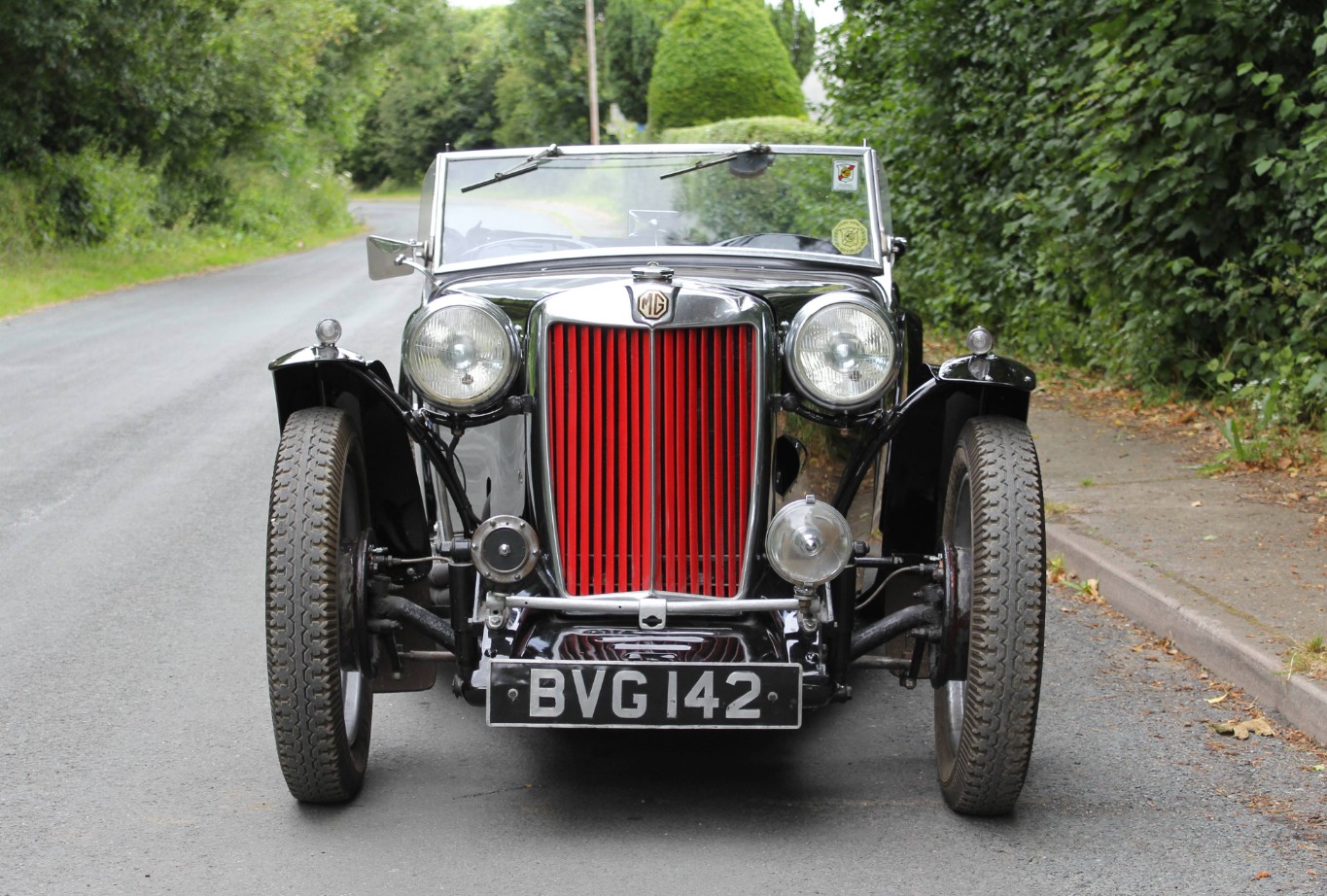
The MG TB of 1939 is the rarest T-Type: just 379 were built before Abingdon was turned over to aircraft components and tank modification. It introduced the 1,250 cc XPAG engine, 54 bhp at 5,200 rpm, and a dry-plate clutch, and was offered as an open two-seater or a Tickford drophead coupé.
- Years
- 1939
- Engine
- XPAG
- Capacity
- 1,250 cc
- Power
- 54 bhp @ 5,200 rpm
- Approximate built
- 379
For the story of the engine itself, its Morris origins, specifications, the enlarged XPEG and its known weak spots, see the XPAG engine hub.
To place a particular car, see how to read its chassis and engine numbers.
Every T-Type body tub is built on wood, so the condition of the ash frame matters more than almost anything else.
Cut short by war
TB production began in the spring of 1939 and ended within months when Abingdon emptied its buildings to build aircraft components and modify tanks for the war effort. Just 379 cars were completed, making the TB the rarest T-Type by a wide margin.
The XPAG engine arrives
The TB introduced the 1,250 cc XPAG engine that would power every T-Type through to the TF. Derived from the Morris Ten Series M but far more highly tuned, it used twin SU carburettors, a 66.6 mm bore and 90 mm stroke, and produced 54 bhp at 5,200 rpm.
Dry-plate clutch and revised gearing
The oil-immersed clutch of the TA gave way to a conventional dry-plate unit, with gear ratios revised to suit the new engine, changes carried forward, essentially unchanged, into the TC.
Bodies: open two-seater and Tickford
TB buyers could choose the traditional open two-seater or the more luxurious Tickford drophead coupé, with wind-up windows and a folding hood, a genuine all-weather MG.
Full reference
MG TB specification and identification
The TB is the rarest T-Series by a wide margin and the one most often described from assumption. It was in production for less than six months, 379 were built, and its significance is not the body, which is essentially the TA's, but the engine underneath it. The TB introduced the XPAG, the unit that would go on to power the TC, the TD, the TF 1250 and the Y-Type. Because so little TB-specific factory literature appears to have been printed, TC data has migrated into TB specification tables across the internet, including on club pages, and this page tries to separate what is recorded from what has been borrowed.
Factory specification
Engine
| Type | XPAG, four cylinders in line, pushrod overhead valve |
|---|---|
| Capacity | 1,250 cc |
| Bore and stroke | 66.5 mm by 90 mm |
| RAC rating | 10.97 hp, commonly quoted as 11 hp |
| Compression ratio | About 7.25 to 1, from Eric Blower's 1957 tuning article covering the TB and TC together. Figures of 7.4 and 7.5 to 1 attach to the TC. No factory TB figure has been located |
| Carburettors | Two SU, semi-downdraught, 1¼ in per the MG Car Club Y-Type Register. Blower's 1957 article gives 1½ in, which conflicts |
| Power | 54.4 bhp at 5,200 rpm. See the note below on where this figure comes from |
| Torque | Not established for the TB. No source located gives one |
| Block casting number | 24001, with an octagonal MG logo and a diamond Morris Motors logo |
| Cylinder head casting number | 22952 |
| Timing chain tensioner | None. The tensioner arrived with the TC block, casting 24142, from engine XPAG/883 |
Transmission
| Gearbox | Four speeds, first gear unsynchronised |
|---|---|
| Synchromesh | Second and third are permanently meshed and synchronised through friction cones. Top is direct drive taken up through dog teeth. First is a crash-meshing sliding gear |
| Ratios | 3.38, 1.95, 1.36, 1.00. Identical to the TC |
| Clutch | Borg and Beck single dry plate, 7¼ in, replacing the TA's cork insert clutch running in oil |
| Rear axle | 5.125 to 1, against the TA's 4.875 to 1 |
Chassis and running gear
| Brakes | Lockheed hydraulic, 9 in drums on all four wheels. Carried over from the TA, not a TB change. Drum width not established |
|---|---|
| Suspension | Half elliptic leaf springs front and rear, beam front axle, live rear axle, sliding trunnions at the spring ends, Luvax hydraulic lever arm dampers |
| Steering | Bishop cam. Single club source, not disputed anywhere |
| Wheels | 19 in centre lock wire |
| Tyres | 4.50 by 19. Given for the TA and the TC but not on any TB source located, so this is a safe inference rather than a sourced figure |
Dimensions and weight
| Wheelbase | 7 ft 10 in, 2,388 mm |
|---|---|
| Track, front and rear | 3 ft 9 in, 1,143 mm |
| Overall length | 11 ft 7 in. Wikipedia gives 140 in, one inch different, probably the same measurement rounded |
| Overall width | 4 ft 8 in. This is a tertiary figure and the MG Owners' Club TB page gives no width at all |
| Overall height | Not established. No source located gives one, hood up or down |
| Weight | About 15.5 to 16 cwt, roughly 1,740 to 1,790 lb. Neither source states whether this is dry, unladen or kerb, and on an ash framed body that difference is material |
No period road test of a TB has been found, and that is a finding rather than a gap in the search. Motor Sport's own cumulative road test indexes of July 1939 and March 1942 both list its MG Midget tests and neither includes a TB, and a 1942 Motor Sport article records a reluctance among manufacturers to submit cars to the press in the preceding years. The car had roughly four months of peacetime with the press before rationing began. The archive was not able to reach the Autocar or The Motor indexes for 1939, so whether either tested a TB is not established, and a reader holding a 1939 Autocar or Motor is invited to say so. What circulates instead should be treated carefully. The MG Owners' Club's TB page gives 87 mph and 0 to 60 in 22.7 seconds, but the same club's TC page gives 78 mph and 27.25 seconds for a car with the same engine, the same gearbox ratios, the same axle and a slightly wider body, and the 22.7 second figure is the one Wikipedia attributes to the TC. That looks like cross-contamination between pages rather than a measurement. One genuine period figure does exist: Motor Sport in July 1942 recorded the TB running 3,130 rpm and 1,860 ft per minute piston speed at 50 mph, against 2,930 rpm and 1,970 ft per minute for the TA. That is a real contemporary comparison, and it says more about what the engine change achieved than any top speed claim. On the 54.4 bhp at 5,200 rpm figure in the table above: the TB figure and the TC figure are the same figure, no located source distinguishes them, and it is likely that the TB number in circulation is the TC's output applied backwards. It is probably right, because the engines are essentially the same unit, but the archive would rather say that than imply an independent TB measurement. These are in any case 1939 manufacturer's figures, quoted gross on the engine with no agreed test standard behind them, and not comparable with modern outputs.
Sources for these figures
- MG Car Club T Register, factory production records and Roger Wilson's document on XPAG casting numbers.
- MG Car Club Y-Type Register, The X Factor: Origins of the XPAG, for gearbox ratios, axle ratios and carburettor sizes across the range.
- Eric Worpe, TB and TC Gearbox Synchromesh, Totally T-Type 2 issue 67, August 2021, for how the synchromesh actually works.
- J. S. Lowrey, The development of the M.G. Midget, Motor Sport, July 1942, for the period account of why the engine changed.
- Eric Blower, Tuning the XPAG Engines Fitted to the Series TB, TC and TD, Motoring, 1957, for compression ratio and carburettor data listed under Standard Car Data: TB and TC.
- MG Owners' Club model pages, used for dimensions and general specification, and treated with care where its TB and TC pages disagree with each other.
- A note on sourcing: no TB instruction manual, workshop manual or service parts list appears in the known listings of factory literature, only three sales brochures. If none was printed, that would explain why TC figures have been borrowed for the TB so widely.
Chassis and engine number identification
Where the numbers are
The chassis number is stamped on the near-side dumb-iron or chassis extension, and should agree with the plate on the battery box or bulkhead. The engine number is on a plate on the left-hand side of the flywheel housing. Where that plate is missing or is an obvious replacement, the block casting number is the fallback: 24001 is a TB block, 24142 is a TC block.
Telling a TB from a TA
Outwardly they are very close to identical, and a 1942 Motor Sport article said as much at the time: chassis and body remained much as before. The differences are mechanical and they are decisive. A TA has an MPJG engine of 1,292 cc, 63.5 mm by 102 mm, a cork insert clutch running in oil, a 4.875 to 1 axle and little or no synchromesh. A TB has an XPAG of 1,250 cc, 66.5 mm by 90 mm, a dry plate clutch, a 5.125 to 1 axle and synchromesh on second and third. Note the direction of that change: the TB's engine is smaller than the TA's, by 42 cc. It is a shorter stroke, larger bore, higher revving unit, not a bigger one. If a car has an XPAG in it and a TA chassis number, it is a TA with a later engine, which is a common and long-standing swap.
Telling a TB from a TC
These are mechanically almost the same car and differ chiefly in the body. The TC tub is about four inches wider across the seats, and that is the figure to hold on to, because the chassis, wings and running boards were not changed. The often repeated claim that a TC is four inches wider overall is wrong. Beyond the body, TB engine numbers run from XPAG/501 to about XPAG/882 and TC numbers from XPAG/883 upward, the TB block is casting 24001 with no timing chain tensioner and the TC block is casting 24142 with one, and a pre-war car has three tread strips on its running boards where a TC has two on narrower boards. The tread strip check is the weakest of these, because running boards get replaced.
Four things commonly got wrong
That the TB has a bigger engine than the TA: it has a smaller one. That the TB introduced hydraulic brakes: the TA already had Lockheed hydraulics with 9 in drums. That the XPAG is an overhead camshaft engine: it is a pushrod overhead valve engine, and any source calling it a cam engine is not a source. And that the war stopped TB production on 3 September 1939: 84 TBs were built after that date and the works ran on until 20 October.
Full number formats for every T-Type are set out in Chassis & Engine Number Identification, and the lookup procedure in Production Records.
Production figures
| Total built | 379 |
|---|---|
| Open two seaters | 319 |
| Tickford drophead coupés | 60 |
| Production began | 1 May 1939, with two prototypes in April |
| Production ended | 20 October 1939 |
| Built after war was declared | 84 |
| Chassis numbers | TB0252 to TB0630, per the T Register. John James's reading of the factory production records implies TB0251 to TB0629 |
| Engine numbers | From XPAG/501. The end of the range is not published and is only inferred from the TC starting at XPAG/883 |
| Survivors | About 208 worldwide, roughly 55 per cent of production, of which 64 to 84 in the United Kingdom |
The 379 figure is not an estimate. It comes from the MG factory production records by way of John James in Totally T-Type 2, and it includes the 60 Tickford drophead coupés, so the open two seater total is 319. Two club-primary sources disagree by exactly one car at each end of the chassis range, the T Register publishing TB0252 to TB0630 and James's reading of the records implying TB0251 to TB0629. Both give 379 cars. The archive records both and does not pick between them. The Tickford cars sit inside the same chassis sequence rather than in a series of their own, which is confirmed by several individually documented cars. One correction worth making: production did not stop when war was declared on 3 September 1939. Eighty-four TBs were built after that date and the works ran on for another seven weeks.
What to check on a MG TB
Read the chassis number, then check it against the factory record
The number must begin TB and must fall roughly within TB0251 to TB0630. The single decisive check available to a private buyer is the MG Car Club T Register's searchable factory production records, which return the chassis number, the Production Car number, the original engine number, the production date and the Register's notes on later changes. The Register points out that these are a digital copy of the original paper records and have not been amended in the light of later information.
Read the engine number, and know what it does and does not prove
An XPAG numbered above 883 is a post-war unit. That does not mean the car is not a TB. The factory itself recorded engine changes, and given that the TB went straight from a six month production run into a war, a great many have been re-engined. The chassis number and the factory record determine what the car is. The engine number tells you only what is in it now.
Check the body width across the seats
A TC tub is about four inches wider than a TB's. Measured against a known TC this is a reliable check, and it is the one that separates the two cars when the engine has been changed.
Expect a car that has been apart
The TB was in production for under six months and then went into a war and a post-war period of extreme scarcity. Documented survivors include a car converted to a four seater and supercharged for racing, found decades later with a chassis that had been rolled at least three times, and a car rescued from a Glasgow scrapyard for about £30. A wholly original TB should be treated as the exception rather than the expectation. That is a reasoned inference from the documented cases rather than a counted statistic.
Be alert to the substitution in both directions
The TB is worth more than either neighbour, is outwardly identical to a TA and is mechanically almost identical to a TC, so the incentive is obvious. The archive found no published survey of how often it happens and will not assert a frequency. What it can say is that the chassis number, the factory record and the body width settle it, and that all three are available to a buyer before any money changes hands.
Understand what you are buying into on parts
See the note on parts below. The short version is that the TB sits across a parts boundary in a fortunate way, and the 379 figure is not the parts problem it looks like.
MG TB parts supply and running costs
The TB sits across a parts boundary
Almost nothing on the car is unique to 379 cars. Its chassis, body, wings, running boards, brakes, axles, wheels and most trim are TA items, shared with just over three thousand cars. Its engine, clutch and gearbox are TC items, shared with ten thousand. The trade organises itself accordingly: the principal suppliers catalogue under a single TA, TB and TC heading with no TB subdivision at all. What is genuinely TB-only, and therefore genuinely hard, is not established from any source the archive reached. The obvious candidates are badging, nameplates and scripts, and whatever bracketry the dry clutch installation required in a TA derived chassis. If you know, the archive would like to hear from you.
The literature gap, which is a TB problem in itself
The known listings of factory literature record three TB sales brochures and no TB instruction manual, workshop manual or service parts list, while listing several TC publications by number. Whether a TB instruction manual was ever printed is not established. If it was not, that would go a long way to explaining why TB owners work from TC documentation, and why TC specifications have found their way into TB tables so widely.
Current suppliers and restorers are listed in the Specialists directory, and cars currently offered for sale in On the Market.
What a MG TB is worth
| Project | Good | Excellent | Concours |
|---|---|---|---|
| Too few sales | Too few sales | Too few sales | Too few sales |
Source: Author analysis of published auction records (2025). Indicative ranges, not valuations, see the Values & Price Guide for condition definitions and caveats.
Common MG TB questions
- What engine does the MG TB have?
- The XPAG, of 1,250 cc, 66.5 mm bore by 90 mm stroke, a pushrod overhead valve four. The TB introduced it, replacing the TA's MPJG. Counter-intuitively the XPAG is the smaller engine of the two, by 42 cc. It is shorter in the stroke, larger in the bore and counterbalanced, which is what let peak engine speed rise from 4,800 to 5,250 rpm.
- How many MG TBs were built?
- 379, from the factory production records rather than an estimate. That total includes the 60 Tickford drophead coupés, so 319 were open two seaters. Production ran from 1 May to 20 October 1939.
- Is the TB the rarest T-Series?
- Yes, by a wide margin. 379 were built against about 3,003 TAs, 10,001 TCs, 29,664 TDs and roughly 9,600 TFs. The reason is simply that it was in production for less than six months before the war ended it.
- Did the war stop TB production?
- It ended it, but not on the day war was declared. Britain declared war on 3 September 1939 and 84 TBs were built after that date, with the works running on until 20 October. The commonly repeated claim that production stopped on 3 September is wrong.
- What is the difference between an MG TA and an MG TB?
- Outwardly almost nothing, and mechanically a great deal. The TB has the XPAG engine where the TA has the MPJG, a Borg and Beck dry plate clutch where the TA has a cork insert clutch running in oil, synchromesh on second and third, and a 5.125 to 1 axle against the TA's 4.875 to 1. Hydraulic brakes are not a difference: the TA already had them.
- What is the difference between an MG TB and an MG TC?
- Chiefly the body. The TC tub is about four inches wider across the seats, though the chassis, wings and running boards were unchanged, so the car is not four inches wider overall. Mechanically the two are almost the same, with the TC block gaining a timing chain tensioner from engine XPAG/883 and changing casting number from 24001 to 24142.
- What are the MG TB chassis numbers?
- The T Register publishes TB0252 to TB0630. John James's reading of the factory production records implies TB0251 to TB0629. Both give 379 cars, and the archive records both rather than picking between them. Engine numbers run from XPAG/501; the end of the range is not published and is only inferred from the TC beginning at XPAG/883.
- What is a TB Tickford?
- A drophead coupé with a proper folding hood and wind-up windows, bodied by Salmons and Sons of Newport Pagnell under the Tickford name. Sixty were built out of the 379, and they sit inside the same chassis sequence as the open cars rather than in a series of their own.
- How many MG TBs survive?
- About 208 worldwide, roughly 55 per cent of production, of which somewhere between 64 and 84 are in the United Kingdom. That figure comes from John James in Totally T-Type 2.
- What is an MG TB worth?
- The archive does not publish a value band for the TB and does not think one can honestly be drawn. The number of publicly recorded sales is very small, they are spread across nearly twenty years, and they mix open two seaters with the rarer Tickford dropheads. Any band built from that would be arithmetic dressed up as knowledge. For a sense of the market rather than a valuation, see the values page.