The SU electric pump has the most famous failure mode in British classic motoring, the silence where the tick used to be. It is almost always fixable at the roadside if you know where the pump lives, how to free stuck points, and how to rule out a blocked fuel-cap vent first.
You are driving along without a care in the world. The engine stumbles, then dies. You turn the key off and on. Nothing, and, more tellingly, no reassuring tick, tick, tick. This is the SU electric fuel pump, and this is the most famous failure in British classic motoring. It is also, usually, fixable where you stand.
First: find out where yours is
Position varies across the T-Series, and it is worth establishing on your own car before you ever need the knowledge in the dark. On the TF the pump is mounted low at the rear of the car, out of sight and out of reach with the bonnet raised. Not every T-Type is arranged the same way, and this archive cannot state with confidence where the pump sits on each model, so check your own car rather than assume: follow the fuel line back from the carburettors and see where it leads.
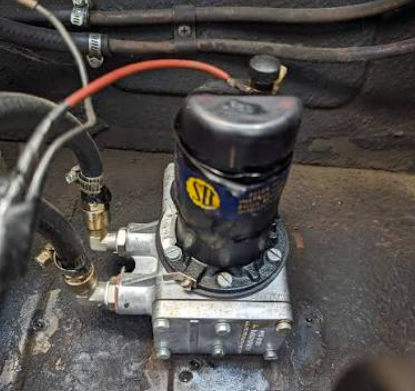
Getting to it is half the job
Most guides photograph a pump sitting on a bench, which quietly skips the part that actually stops people at the roadside. Where the pump lives under the rear of the car, you cannot see it, tap it, or put a meter on it without raising the car first. That means ramps, axle stands on firm level ground, or a lift, none of which is to hand on a wet verge.
Two practical consequences follow. The famous tap on the pump body is only a roadside remedy if you can reach the pump where you are standing. The checks you can make without getting underneath, listening for the tick with the ignition on, cracking the fuel cap, testing the feed and earth where they are accessible, are therefore worth working through first, before you commit to jacking a car up at the side of a road.
The roadside ritual
The traditional first response is to give the pump a few healthy whacks.
This works because the points have stuck, and a sharp jolt frees them. It is not folklore; it is the correct field expedient.
Whack it gently, with a screwdriver handle, not a hammer. The object is to make it tick again, not to beat it into a bloody pulp.
If the ticking returns, drive on. You have not fixed anything, and you may need to repeat the performance before you get home, but you will get home.
Roadside checklist
SU fuel pump, quick diagnosis
Step 1 of 5
1.Ignition on. Is the pump silent, no reassuring tick, tick, tick?
The diagnosis, in order
Work through this rather than guessing:
Disconnect both fuel lines and turn the ignition on.
- Pump doesn't run at all → the fault is in the pump. Stop here; it needs repair or replacement.
- Pump runs freely → the pump is fine. One of your lines is blocked. Continue.
Reconnect the line from the tank only. Ignition on.
- Pump runs and delivers fuel from the outlet → your blockage is in the line onward to the carburettors.
- Pump doesn't run, or clicks a couple of times, stops, and is hot to the touch → your blockage is between tank and pump, or inside the tank itself.
That sequence isolates the fault in minutes and tells you whether you are removing a pump or a fuel line.
If it runs continuously and never stops
A pump that ticks away forever and never settles has an air leak on the inlet side, a split hose, a broken pick-up tube in the tank, or an inlet valve stuck open. A ruptured diaphragm is possible but unlikely; the diaphragm is a rugged component.
There is a simple test. Disconnect the inlet (mind the fuel), remove the wire from the coil so it isn't damaged, switch the ignition on, and put a finger over the inlet hole. The pump should slow down or stop. If it does, the pump is sound and you are looking for a leak upstream.
Points
On a points pump, treat the contacts exactly as you would those in a distributor. With the pedestal rotated back, the lower contacts are exposed enough to clean with a small sharpening stone, or 400-grit paper on a narrow stick. Clean the points on any pump before you fit it, including a rebuilt one.
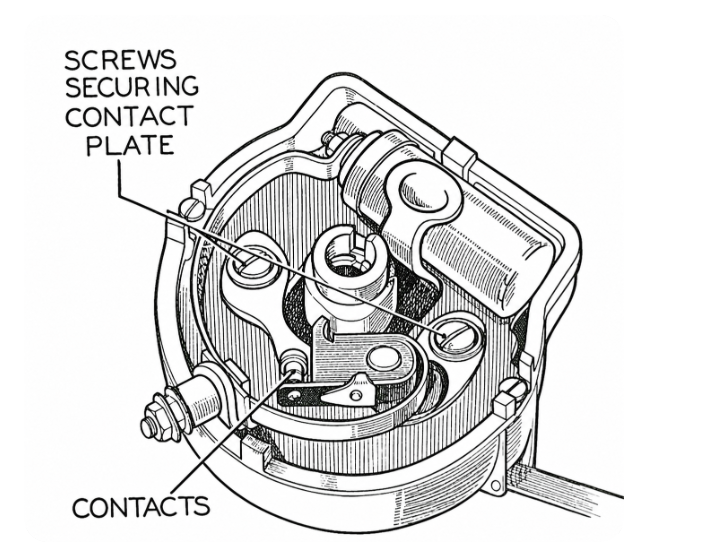
Be careful with the coil connections during servicing. Damage there, or an overload condition, is the most likely cause of the classic mystery failure. One owner completely overhauled the pump on a full restoration, set it up to the workshop manual, bench-tested it, and the car still stopped on its very first test drive. It was the pump.
Voltage, and an honest disagreement
A widely-repeated view holds that most electric fuel pump failures come from running at too low a voltage: high-resistance connections at the feed or earth make the pump work harder, draw more current and overheat. Check the continuity of both the power feed and the earth at both ends, this is sound advice regardless, and costs nothing. One owner's persistent pump failure turned out to be an eight-year-old battery; a new one cured both the no-start and the pump.
In fairness, this is disputed. One owner bench-tested a pump across the range and found duty cycle rising from 0.33 at 14 volts to 0.62 at 8 volts, more work, certainly, but not obviously fatal, and at voltages that low the car would barely run anyway. Nor is there any low-voltage protection circuit in the electronic pumps; they simply stop when there isn't enough to work with.
Check your connections. Don't assume voltage explains everything.
Converting to electronic
The electronic SU pump is mechanically identical to the points version, only the switching differs. That means a standard repair kit serves either; just don't buy a kit containing points for an electronic pump.
Owners who have converted generally report years of untroubled running, and it removes the single most common failure mode. It also removes the roadside whack, which some will consider a loss.
On ethanol: every diaphragm sold today by a reputable supplier is ethanol-resistant. The no-name items on auction sites are another matter.
In defence of the SU pump
Its reputation is worse than it deserves. SU pumps typically fail somewhere around 75,000 to 100,000 miles, which is about where a new SU pump will fail too, and about where the Facet and Japanese SU-clone pumps that people replace them with also die. The SU lasts about as long as anything else on the market, and possibly longer in electronic form.
It is not a bad pump. It is an old design that announces its faults audibly, fails in a way you can hear, and can usually be persuaded back to life with a screwdriver handle. There are worse traits in a car component.
If you have a photograph of your own SU pump, particularly one showing where it sits on the car or the points with the cover off, the archive would be glad of it and will credit you. Get in touch.