A carburettor has one job: mix petrol and air in the right proportion, across every condition from cold idle to full throttle. Here is how it actually does it — and why the MG's SU does it more cleverly than most.
The basic idea — the venturi
An engine draws air in; the carburettor sits in that airflow and adds fuel to it. The trick is the venturi, a deliberate narrowing in the air passage. Air speeds up as it squeezes through the narrow point, and faster-moving air has lower pressure. That drop in pressure draws petrol up out of a jet and into the airstream, where it breaks into a fine, combustible mist. A throttle — a pivoting butterfly flap linked to your foot — controls how much air gets through, and so how fast the engine runs. Fast air, low pressure, fuel drawn in: that is the whole principle.
The hard part — keeping the mixture right
An engine wants roughly fifteen parts air to one part petrol by weight, but its appetite varies enormously: idle to full throttle, stone cold to fully warm, steady cruise to a sudden stamp on the pedal. Delivering the right proportion at every one of those points is the entire art of carburettor design — and it is why more than one type exists.
Two families of carburettor
Fixed-venturi (fixed-jet)
The venturi is a fixed size, so to get the mixture right across all conditions the carburettor needs several separate fuel circuits — an idling circuit, a main circuit, an accelerator pump, a cold-start circuit — each a set of precisely drilled passages and calibrated jets. Solex, Weber and Zenith carburettors work this way. Very precise, but complex, with many jets to get right. (The AC Aceca's Solex is this type.)
Constant-vacuum (variable-venturi)
The venturi size changes automatically to keep the airspeed — and so the suction at the jet — constant, whatever the engine is doing. A single jet, with a tapered needle moving in it, does all the metering and compensates for itself. Far simpler, self-adjusting, and beautifully suited to a road car. The MG's SU and the Triumph Stag's Stromberg are both this type.
How the SU does it
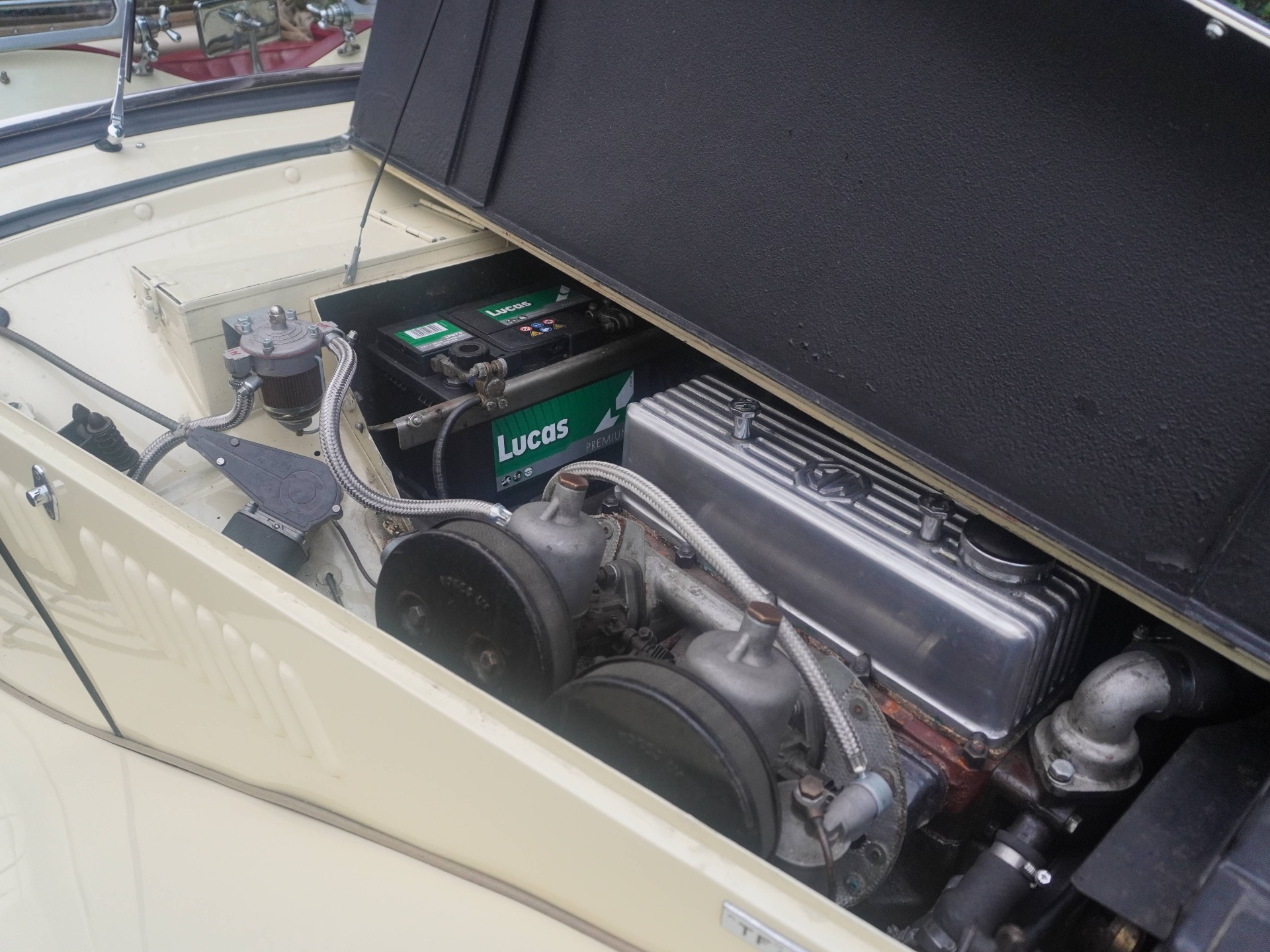
The heart of an SU is a piston that slides up and down inside a chamber called the dashpot, carrying a slim tapered needle that hangs down into a fixed jet.
At idle
The throttle is nearly shut, little air flows, the piston sits low, and the needle nearly fills the jet — so only a trickle of fuel passes.
Opening the throttle
Manifold vacuum rises and is fed, through small drillings in the piston, to the space above it. With lower pressure above than below, the piston lifts. As it rises two things happen together: the gap beneath it widens to admit more air, and the tapered needle draws up out of the jet to admit more fuel. Because air and fuel increase in step, the mixture stays about right — the carburettor meters itself. The piston settles at exactly the height the airflow demands, balanced against its own weight and a light spring. That direct feedback between engine demand and fuelling is why an SU needs one jet where a fixed-venturi carburettor needs many.
The damper — the oil on top
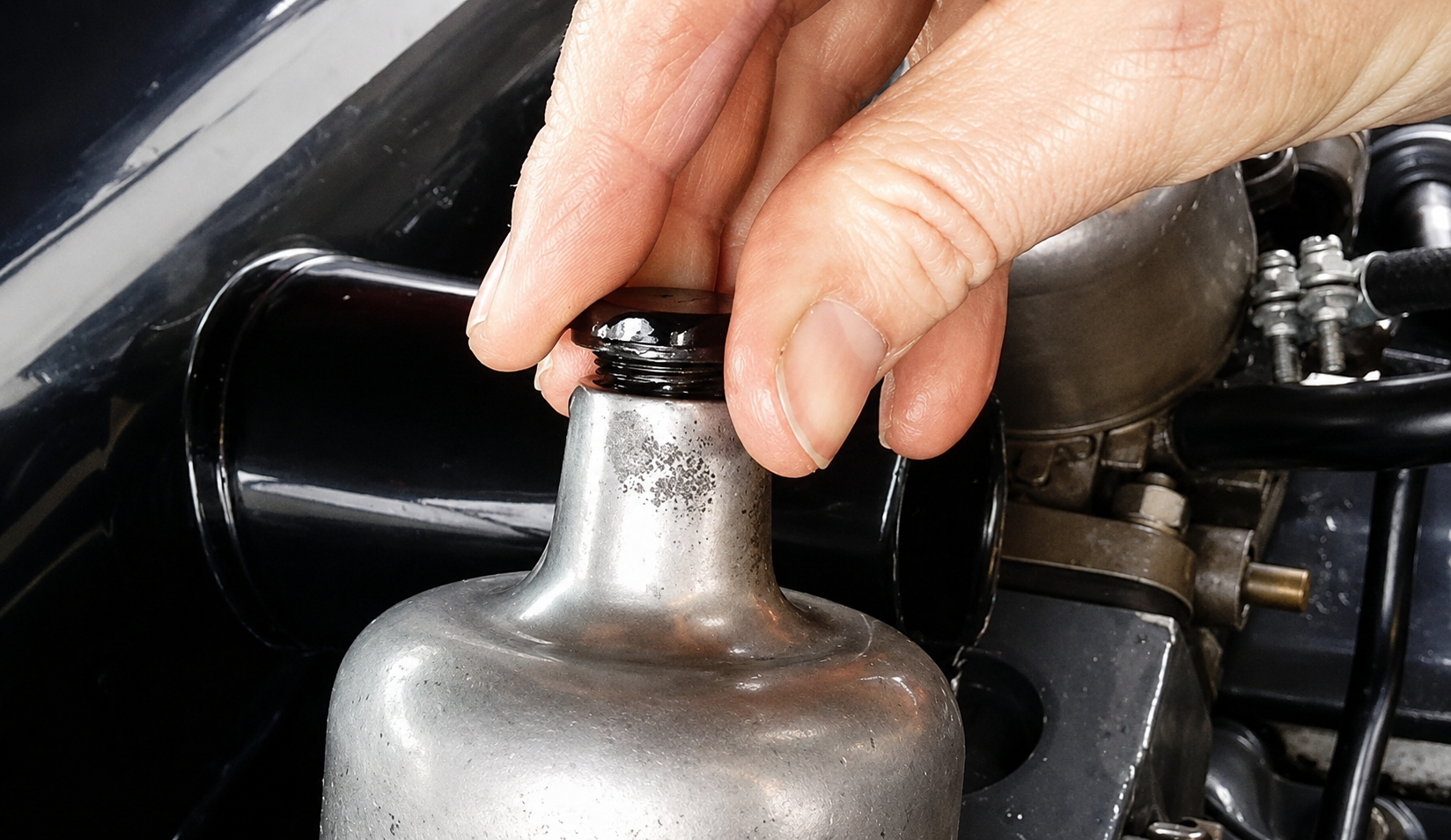
Screw off the cap on top and there is a little oil-filled damper. Stamp on the throttle and the piston would otherwise fly up too fast, leaning the mixture for a moment. The damper slows its rise for a beat, holding the suction up and richening the mixture just when the engine needs it — the SU's built-in acceleration enrichment, doing the job a fixed-venturi carb needs a separate accelerator pump for. This is why the damper oil, of the right grade and topped to the right level, genuinely matters.
Cold starting
Pulling the choke lowers the whole jet down the needle, opening a wider gap for a richer mixture while the engine is cold, and nudges the throttle open slightly to lift the idle.
The float chamber
A float and needle valve hold a steady level of petrol in a small reservoir feeding the jet, so the supply stays constant however the fuel is sloshing about. Getting that level right is part of setting the carburettor up.
Mixture adjustment
Raising or lowering the jet relative to the needle — on a traditional SU, via the jet adjusting nut beneath — sets the mixture richer or weaker. That is the fundamental tuning adjustment, and the setup guide will cover how to do it by ear and by the lifting-pin test.
See it in motion
The animation below walks through the SU at work — idle, acceleration, the float chamber, cold-start choke, and how the twin carburettors stay in sync. Use the controls to pause, slow it down, hide the labels, or jump to any stage.
The main components
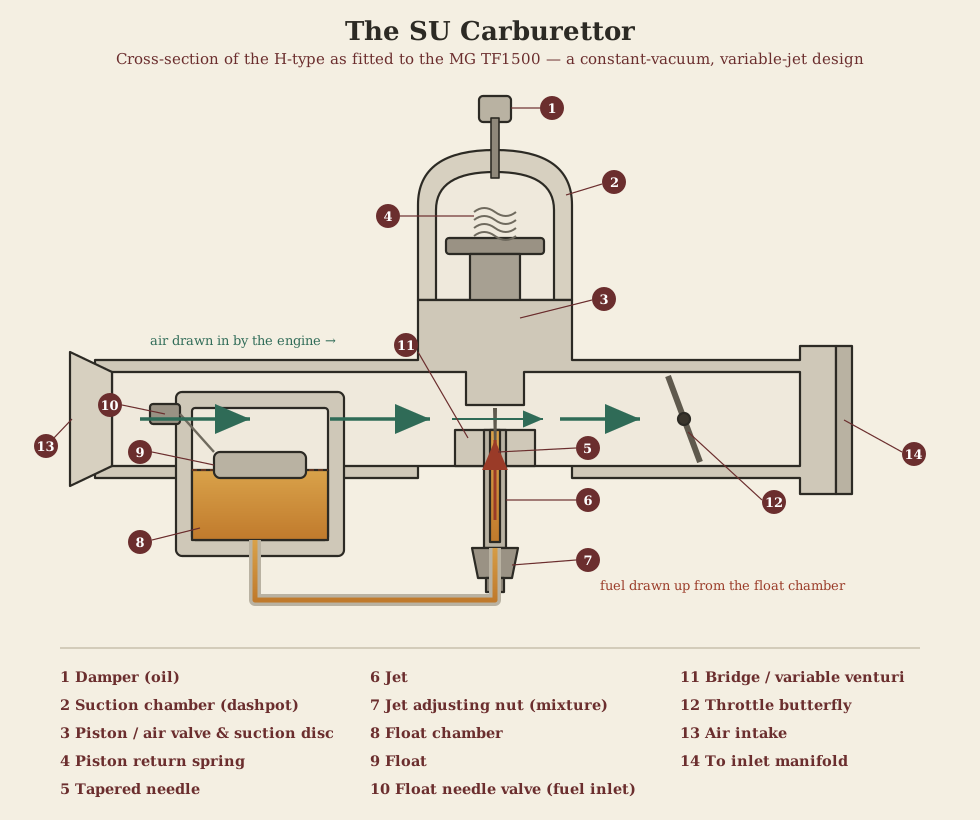
- Damper (oil) — A small oil-filled damper screws into the top of the suction chamber, its plunger sitting in a bath of light oil inside the hollow piston rod. Open the throttle sharply and it slows the piston's rise for a moment, holding up the suction at the jet and briefly richening the mixture — the SU's built-in acceleration enrichment, doing the job a fixed-jet carburettor needs a separate accelerator pump for. The oil's grade and level genuinely matter: run it low or too thin and you get a flat spot on pick-up.
- Suction chamber (dashpot) — The domed chamber in which the piston slides. Manifold depression is fed to the space above the piston through drillings in the piston itself, and the difference between that low pressure above and atmospheric pressure below is what lifts it. It must be clean and unworn so the piston moves freely; a sticking piston is a common cause of poor running.
- Piston / air valve & suction disc — The heart of the SU. This light alloy piston rises and falls to vary the venturi automatically. Its broad top face — the suction disc — seals against the chamber so vacuum can lift it, while its lower face forms the roof of the venturi over the bridge. As it rises it opens the venturi to more air and lifts the needle to admit more fuel in one movement — the self-metering action that defines a constant-vacuum carburettor.
- Piston return spring — A light spring above the piston gives it a gentle, calibrated downward load so it settles at the height the airflow demands, and returns it when the throttle closes. Its rate is matched to the carburettor and needle; it is not a tuning adjustment.
- Tapered needle — A slim, precisely ground needle fixed to the base of the piston and hanging into the jet. Because it tapers, the higher the piston lifts it the greater the effective area of the jet and the more fuel flows. Its profile is chosen to give the right mixture across the range — a different needle richens or weakens particular parts of the rev band, which is how an SU is fine-tuned to an engine.
- Jet — The fixed brass tube up which petrol is drawn into the airstream at the bridge. The needle sits within it, and the ring-shaped gap between needle and jet sets how much fuel passes at any piston height. The float chamber keeps petrol standing at the correct level in the jet, ready to be drawn up the instant the piston rises.
- Jet adjusting nut (mixture) — The single most important tuning adjustment. Turning it raises or lowers the whole jet relative to the fixed needle: drop the jet and the gap opens for a richer mixture; raise it and it weakens. On a traditional SU this is the nut beneath the carburettor, set by ear and by the lifting-pin test. (Later HIF carburettors do the same job with a screw, the jet housed inside the body.)
- Float chamber — The reservoir alongside the carburettor holding a small standing supply of petrol, so fuel is always available at the jet however it is sloshing about in the tank. It is fed from the fuel pump and held at a constant level by the float and needle valve.
- Float — A hollow float rides on the fuel surface, rising and falling with the level and, in doing so, operating the needle valve to keep that level constant. A fuel-soaked or sunken float lets the level climb too high and floods the carburettor.
- Float needle valve (fuel inlet) — The valve where fuel enters the float chamber. The float presses it shut when the chamber is full and lets it open as the level drops, exactly like a cistern's ballcock. A worn or grit-stuck needle valve is a classic cause of flooding or starvation — and, on today's ethanol petrol, of perished seals.
- Bridge / variable venturi — The raised section of the bore floor over which the piston descends. The gap between the piston's lower face and the bridge is the venturi — but unlike a fixed carburettor's it changes size as the piston moves, keeping the airspeed, and so the suction at the jet, roughly constant whatever the engine is doing. The jet emerges through the bridge at the very point of lowest pressure.
- Throttle butterfly — A pivoting disc in the bore, on the engine side of the venturi, linked to the accelerator. It controls how much air, and therefore mixture, reaches the engine, and so its speed. On an SU it is the throttle that sets the airflow and the piston that responds to it, not the other way round.
- Air intake — Where filtered air enters the carburettor, drawn in by the engine's suction on each induction stroke. On a twin-SU T-Series each carburettor has its own intake and air filter.
- To inlet manifold — The flange bolting the carburettor to the inlet manifold, through which the metered mixture passes to the cylinders. On the T-Series two carburettors feed four cylinders through a shared manifold — which is exactly why the pair must be balanced to draw equally.
Why the T-Series has two
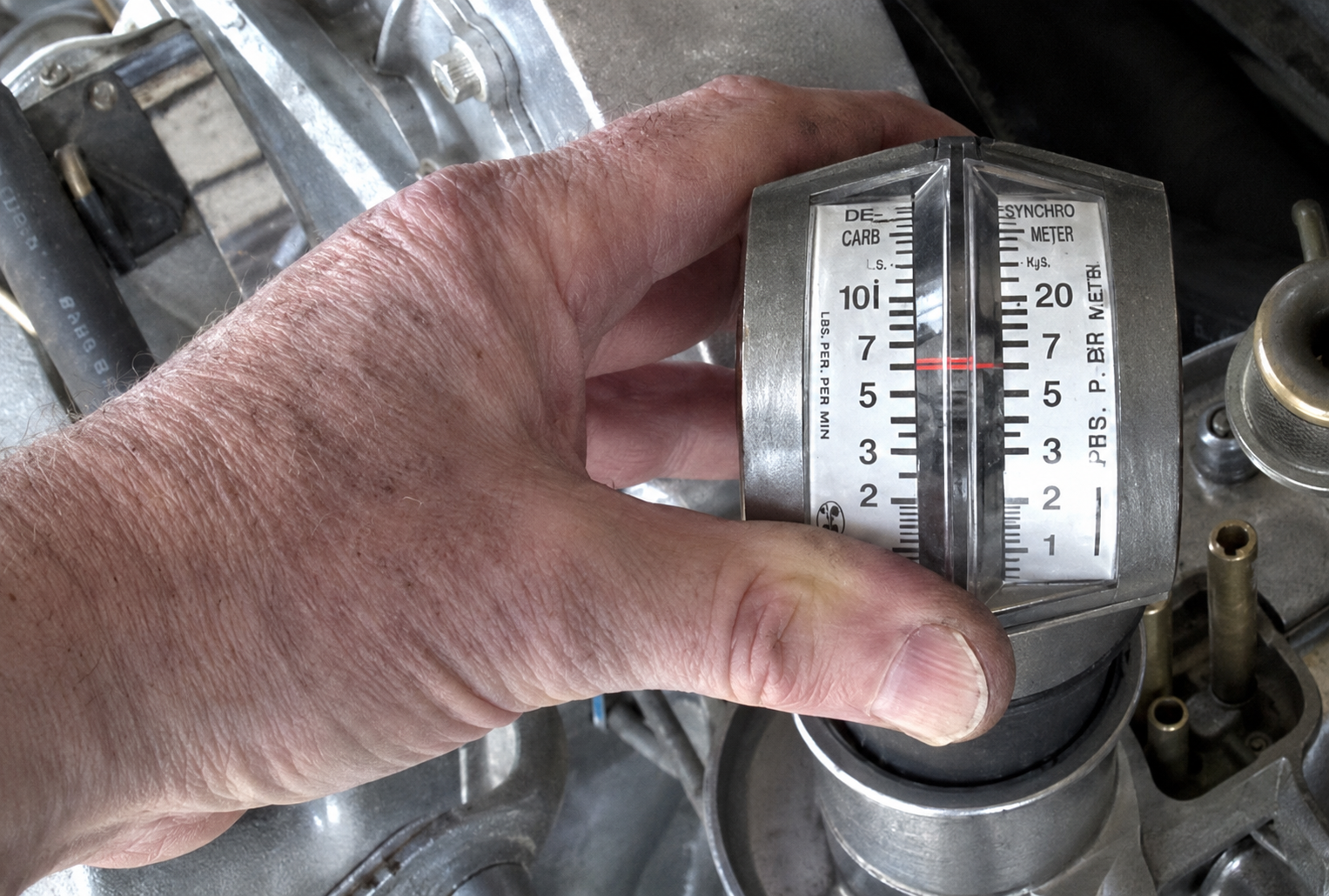
Twin SUs give each pair of cylinders its own carburettor and a shorter, straighter path to the inlet ports — better breathing and sharper response than a single carburettor feeding all four through a long manifold. The price of that is balance: the two carburettors must draw exactly equal air and run matching mixtures, or they pull against each other. Getting them to agree - balancing - is the core of an SU tune-up, or in-fact any carb.
The same goal, three different routes
It is worth knowing how the family's cousins differ, because the principle carries across our other cars. The Triumph Stag's Zenith-Stromberg is the SU's near-twin — the same constant-vacuum idea, but using a rubber diaphragm in place of the SU's metal piston, and adjusted in a different way. The AC Aceca's Solex is from the other family entirely: a fixed venturi, with its metering shared across several fixed jets and circuits. Same job — the right mixture, everywhere — reached by three different pieces of engineering.
With thanks to Andrew at AG Classic Car Tuning, mobile classic-car tuning specialists in North Yorkshire.