The distributor is the brain of a classic ignition system. It does two jobs at once — triggering the spark, and sending it to the right cylinder at the right instant. Here is exactly how, from the points to the rotor.
Two jobs in one
A distributor does two distinct things, and it helps to keep them separate in your head. First, it triggers the coil to make the spark, by making and breaking the coil's low-voltage circuit at precisely the right instant. Second, it distributes that spark, routing the coil's high-voltage output to the correct spark plug in the firing order. The first job is about timing; the second is about direction.
How the spark is made — points and coil
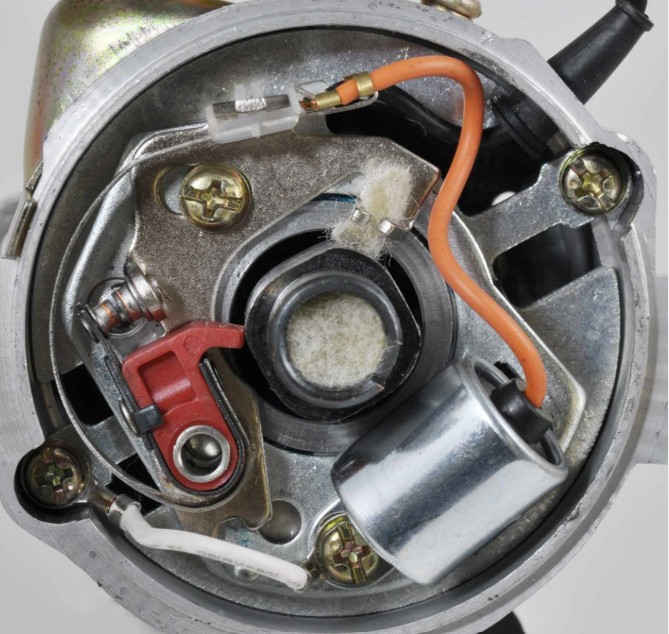
An ignition coil is really a transformer: feed a modest current through its primary winding and it builds a magnetic field; interrupt that current suddenly and the collapsing field induces a huge voltage — tens of thousands of volts — in its secondary winding. That surge is the spark. The switch that makes and breaks the primary current is the contact breaker points: two small contacts inside the distributor. A cam on the distributor shaft, with one lobe per cylinder, pushes them open and lets them snap shut as it turns. Every time the points open, the coil fires — so the points are, quite literally, the trigger. Beside them sits the condenser, a capacitor. As the points open it soaks up the surge that would otherwise arc across them, protecting the contacts from burning and sharpening the collapse of the coil's field for a fatter spark. A tired condenser is a common cause of weak, misfiring ignition.
How the spark is delivered — cap and rotor
The coil's high-voltage output arrives at the centre of the distributor cap, passes down through a spring-loaded carbon brush, and onto the rotor arm spinning on top of the shaft. As the rotor turns, its tip sweeps past the cap's outer terminals — one per cylinder — without quite touching them. Each time it lines up with a terminal, the high voltage jumps the tiny gap, races out along that cylinder's HT lead, and fires its plug. Spin the rotor in step with the engine and each cylinder gets its spark in turn.
Why it turns at half engine speed
The distributor is driven by a gear off the camshaft, so it turns at half crankshaft speed. A four-stroke engine fires each cylinder once every two turns of the crank, so one full turn of the rotor serves one complete firing cycle of all the cylinders. The same shaft usually drives the oil pump below.
The clever part — the advance mechanisms
What separates a distributor from a simple switch is that it does not fire at a fixed moment. The spark needs to happen earlier as the engine speeds up, and can be nudged earlier still under light load for economy. The distributor does both automatically.
Centrifugal (mechanical) advance
A pair of hinged weights on the shaft, held in by springs. As revs rise they swing outward against the springs and twist the cam a few degrees ahead, advancing the spark. The faster the engine, the more advance, up to a built-in limit.
Vacuum advance
A diaphragm connected to carburettor or manifold vacuum. Under light load — cruising, high vacuum — it rotates the points plate to advance the timing for better economy; under hard load, low vacuum, it backs off, guarding against pinking. Together with the base setting, these serve the engine the right advance at every combination of speed and load — the subject of the ignition-timing page.
What goes wrong, and upkeep
Being mechanical, a distributor wears. Points burn and their gap drifts, so they need checking every few thousand miles; the condenser fails; the cap and rotor track or corrode; and — the big one — the shaft bushes wear, letting the shaft wobble so the timing wanders and can't be set accurately. Weak or sticking advance springs throw the advance curve out. Most of this is cheap DIY maintenance; worn bushes mean a rebuilt or replacement distributor. Many owners fit an electronic ignition conversion — a Hall-effect or optical trigger replacing the points inside the same distributor — which removes the points' wear and drift for a steadier spark and no more regular adjustment, while keeping the advance mechanisms. It is one of the most popular reliability upgrades.
With thanks to Andrew at AG Classic Car Tuning, mobile classic-car tuning specialists in North Yorkshire.