The MG T-Series was never painted in a colour called "British Racing Green" at the factory. Abingdon used named nitrocellulose shades, Apple Green on the pre-war cars, Shires and Almond Green in the TC years, Woodland Green on the TD, and Almond and Sherwood Green on the TF. "BRG" is a national racing colour, not a paint code, and the exact shade shifted decade by decade. If you want a period-correct car, match the specific factory name for your model and year, not a modern tin labelled BRG.
Answer-first: what was actually on the car
- TA (1936–39): nitrocellulose lacquer. Standard palette included Apple Green, Duo-Blue, Duo-Green, black and maroon. There was no "BRG" option.
- TB (1939): same lacquer chemistry, same short list of colours, production was cut off by the war before a wider palette landed.
- TC (1945–49): post-war austerity meant a very short list. Shires Green, Almond Green, black, MG Red (Regency Red) and Clipper Blue account for almost every car.
- TD (1949–53): Woodland Green, Almond Green, Ivory, Black, MG Red and Clipper Blue. Woodland is the darker, more familiar "MG green" of the 1950s.
- TF and TF 1500 (1953–55): Almond Green, Sherwood Green, Black, Ivory, MG Red and Birch Grey. Two-tone schemes appeared on the TF.
All T-Series cars left Abingdon in nitrocellulose lacquer, not modern acrylic or two-pack. That matters if you are trying to match an original patch under the bonnet or on the inside of a door.
The T-Series timeline
1936 – 1955 · tap a marker to explore
1936, MG TA, the series begins
3,003 built · £222 new
Bigger, more comfortable and pushrod-powered, the TA opened the T-Series in 1936. It was originally called simply the 'T Type', the name TA only came into use once the TB arrived. Steel body over ash frame on a separate chassis.
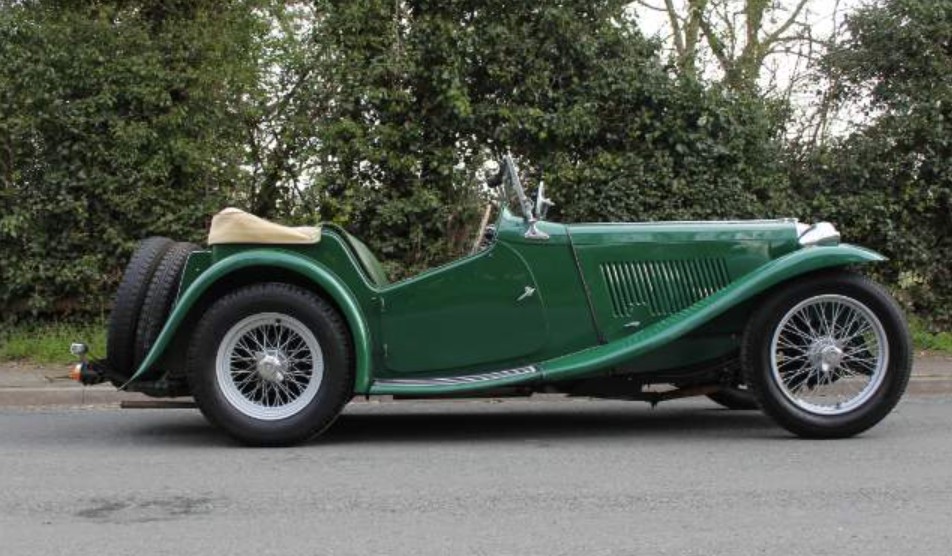
What "British Racing Green" actually means
British Racing Green is a national racing colour, assigned to British entries in international motor sport from the Gordon Bennett Cup of 1902 onwards. It is a category, not a formula. Over a century of racing, "BRG" has been everything from the very dark, almost-black green of the pre-war Bentleys and ERAs, through the mid-green of the 1950s Vanwalls and Lotus 25, to the lighter, brighter greens seen on Jaguars at Le Mans and BRMs in Formula 1.
Because it was never a single paint code, every marque interpreted it differently, and every era did too. When someone says "paint it BRG", they usually mean *a* dark green. When a judge at a concours says a T-Type looks "wrong in BRG", they usually mean it has been sprayed in a modern, generic dark green instead of the specific Abingdon shade the car left the factory in.
Abingdon never ordered a tin of paint labelled "British Racing Green". The factory ordered Apple Green, Shires Green, Almond Green, Woodland Green and Sherwood Green, each with its own ICI or Docker Brothers reference, and each subtly different from the next.
The Abingdon greens, in order
Apple Green (TA, some TB)
A bright, slightly yellow-tinged mid-green, closer to a modern "British Sports Car Green" than to any dark racing shade. Original Apple Green cars in daylight look almost cheerful next to a modern BRG restoration, a useful reminder that pre-war MG was still a small maker courting weekend drivers, not a works racing team.
Shires Green (TC)
A darker, slightly greyer green than Apple. Applied over primer and often finished with a dark-red or biscuit interior. Shires is the shade most often confused with "BRG" on surviving TCs, because in a sunless workshop the two look near-identical, but held to the light Shires has a warmer, softer note that generic BRG does not.
Almond Green (TC, TD, TF)
The longest-lived Abingdon green: introduced on the late TC, kept on the TD, and offered again on the TF. Almond is a pale, sage-like green, much lighter than most people expect. Many owners assume their Almond Green TF must have faded because the modern eye reads "green MG" as "dark green MG"; in fact the factory shade was always this soft.
Woodland Green (TD)
The classic "MG green" most people picture: a rich mid-to-dark green, deeper than Almond, warmer than the modern generic BRG. Woodland is the shade closest to what the pre-war Bentleys wore at Le Mans, and closest to what the eye now expects on a 1950s British sports car.
Sherwood Green (TF, TF 1500)
Introduced with the TF. Sherwood is a deep, cool, blue-shifted green, noticeably bluer than Woodland, and darker than Almond. On a two-tone TF (Sherwood over Ivory or Sherwood over Almond) it is unmistakable. This is the shade closest to the "BRG" the modern eye expects, and the one that has quietly become the default when people paint a T-Type "green" today.
Interactive gallery
Abingdon paint swatches
Hover or tap a swatch for details. Colours are on-screen approximations, see the caution below before matching paint.
Greens
Reds
Blues
Neutrals
Apple Green
TA · early TB · 1936–1939 · #6B8E3D
Bright, yellow-tinged mid-green. Much lighter than the modern eye expects on a pre-war MG, closer to a period 'sports green' than any dark racing shade.
Caution · Hex values here are indicative screen approximations compiled from surviving factory chips, Heritage Certificate references and marque-club colour libraries. Monitors, browsers and ambient light all shift the result. Never mix a tin of paint from a hex code alone, take a physical chip (an unfaded patch from inside a door, under the bonnet or behind trim) to a specialist and have it matched in the correct chemistry. Original T-Series paint was nitrocellulose lacquer, not modern acrylic or two-pack.
Why factory paint codes matter
Two reasons, one practical and one financial.
Practical. Nitrocellulose lacquer looks different from modern two-pack. It is slightly softer, slightly matt when unpolished, and it sinks into the ash frame's grain in a way modern paint does not. A car resprayed in a generic modern BRG will read "wrong" to anyone who knows the marque, even if they cannot articulate why. Matching the correct factory shade, in the correct chemistry, where possible, is what separates a car that looks like a T-Type from one that looks like a nice green sports car.
Financial. In the concours world, and increasingly in the mainstream classic market, originality of colour is checked. A TD in Woodland Green with a matching Heritage Certificate is worth more than the same car repainted in generic BRG. When the factory record (available via the MG Car Club T-Register production records) lists the original colour, matching it back to the car during restoration is the single easiest way to protect value.
Matching an original patch
If your car has been repainted and you want to find the factory shade:
- Look inside the boot lid, under the bonnet frame, and inside the door shuts. These areas often carry a surviving patch of the original nitrocellulose beneath later coats.
- Look under the fuel tank on a TC or TD, an area rarely stripped in a repaint.
- Take the patch to a specialist. Modern spectrophotometers can read even a small patch of old lacquer and give you a factory-matched formula. UK specialists including our recommended paint and trim suppliers can produce nitrocellulose or two-pack matches to Abingdon originals.
- Cross-check the Heritage Certificate. The factory record names the colour the car left in, if a patch matches that name, you have your answer.
The "correct" BRG for a T-Type
There is no single correct BRG for a T-Type, because Abingdon never used the label. If a customer asks a body shop for "British Racing Green" on a TD, the honest answer is a question: do you want your car repainted in its factory colour, or in a modern generic green? The two are not the same.
For most owners, the answer is the factory shade, Woodland on a TD, Sherwood or Almond on a TF, Shires or Almond on a TC. If you specifically want a racing-green feel, Sherwood is the closest of the Abingdon greens to what the modern eye reads as "BRG", and it is a genuine factory colour.
Frequently asked questions
Why does my tuned XPAG misfire under load?
Misfire under load is almost always ignition on an XPAG, not carburation. Check the plug gaps and colour first, sooty plugs mean the mixture is rich or the ignition is weak; white or blistered electrodes mean it is lean. Then confirm the points gap and dwell, the rotor arm and condenser, and that the coil is producing a strong blue spark. On a Stage 1 or Stage 2 engine, also check the static timing has not crept too far advanced; a pinking engine often feels like a misfire and will eventually burn a hole in a piston. Finally, balance the SUs again, an unbalanced pair can leave one cylinder running lean enough to misfire at wide throttle.
Why does my XPAG hesitate when I open the throttle?
Hesitation on pick-up is the classic SU weak-mixture signal. The piston in the carburettor is lifting too fast for the fuel to follow, usually because the jet is set too lean, the needle is worn, or the dashpot oil is too thin. On a Stage 1 car with standard 1.25 in SUs, start by checking the damper oil level and weight, SAE 20 is correct, and that the piston rises smoothly without sticking. Then richen each jet by one flat, test again, and confirm with the lifting-pin method. On a Stage 2 car with 1.5 in SUs the same rule applies, but the needle profile is more critical; a worn or mismatched needle will hesitate whatever the jet setting.
Why is my tuned XPAG hard to start when hot?
Hot-starting problems on a tuned XPAG usually come down to fuel evaporation or flooding. A free-flow exhaust and a hot engine bay can boil the fuel in the float chamber and carburettor body, making the mixture over-rich. Check the float level first, it should be at the workshop-manual figure, not simply "looks about right". If the car starts cold but floods hot, try easing the throttle fully open while cranking to clear the cylinders, then start with no throttle. On Stage 2 engines with raised compression the starter also has to turn a higher-compression engine against a hot block; a good battery and clean earth straps matter more than on a standard car.
My Stage 1 XPAG pings on acceleration, what do I adjust?
Pinking means the combustion pressure peak is arriving too early. On a Stage 1 tune running on modern 95 RON petrol, retard the static timing by one or two degrees first and re-test on a warm day under load. If it still pings, check that someone has not already advanced the distributor beyond the Stage 1 figure, verify the compression ratio has not been raised by a previous skim, and make sure you are not running the engine below about 1,500 rpm in a high gear. Do not simply richen the mixture to mask pinking, it helps a little, but the real fix is timing or compression.
After fitting 1.5 in SUs my Stage 2 idle hunts, what is wrong?
An uneven idle after a Stage 2 carburettor swap is usually one of three things: the throttle spindles are worn and drawing air, the inlet manifold is not matched to the head ports and is causing reversion pulses, or the jets and needles are not centred and matched. Re-check the manifold face and gasket match, recentre both jets with the piston-drop test, and confirm both carburettors are drawing the same airflow at idle. Stage 2 engines with a fast-road cam also have less manifold vacuum at idle, so the idle speed may need to be set a little higher than standard, typically 800–900 rpm, to keep the SUs stable.
How do I know if my tune is running lean?
Lean running shows up as a flat spot under load, popping in the exhaust on the overrun, white or grey spark-plug insulators, and elevated exhaust-manifold colour after a run. On a rolling road the air/fuel ratio will read above 14.5:1 at cruise or above 13.0:1 at wide throttle. Fix it by richening the mixture a flat at a time on the SUs, checking for air leaks around the manifold and balance pipe, and confirming the fuel pump is delivering at least 1.5 psi at the carbs. Lean mixture is the fastest way to burn exhaust valves on a tuned XPAG, so do not ignore it.
Related reading
- MG T-Series Story: Abingdon to America, the wider history of the marque and how the paint palette fits into it.
- Look Up Your Car's Factory Record, the MG Car Club T-Register service that returns the original factory paint colour for your chassis number.
- Ash Frame Rot, why the underlying woodwork affects the finish, and why nitrocellulose behaves differently on ash than on steel.