The prettiest and the last of the Abingdon T-Types, built 1953–1955, 9,602 made including two prototypes, of which 3,400 were 1500s. The single most important thing you can do when buying one is verify the engine, because a TF 1500 cannot be identified by its badge or its chassis number.
What you're buying
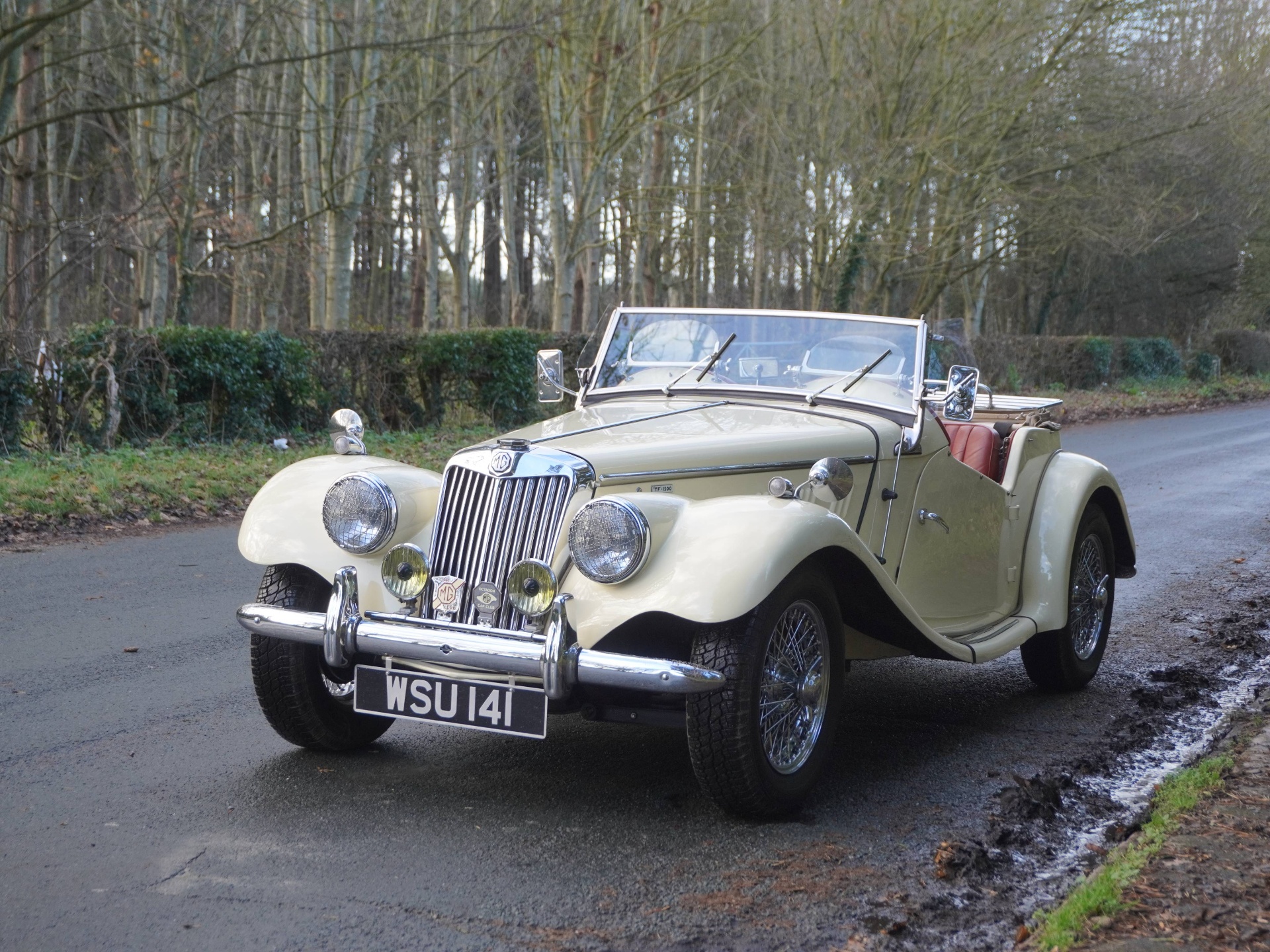
Launched 15 October 1953, the TF is a facelifted TD: headlamps faired into the wings, a sloping grille concealing a separate radiator, pressurised cooling with a simulated filler cap, and the TD Mark II engine at 57.5 bhp. It shares the TD's independent front suspension and rack-and-pinion steering, so it drives like a TD and looks better doing it.
It was a stopgap, and it was criticised on launch for lacking power, the Triumph TR2 would do over 100 mph; the TF managed about 80. Its handling and roadholding were never the problem.
The TF 1500 warning, read this before you buy
From late 1954 the XPEG arrived: the XPAG bored to 72 mm via siamesed cylinders for 1,466 cc, stronger rods, 8.3:1 compression, 63 bhp. It is worth more and it is frequently misrepresented.
You cannot identify a TF 1500 by its badge, and you cannot identify it by its chassis number. Only the engine tells the truth.
Two reasons. First, the earliest 1500s carried no nameplate at all, at least up to the October 1954 London Motor Show cars, chassis TF/7252 and TF/7253. Second, and more importantly, there is no reliable correlation between chassis number and engine type, because XPEG units went in in alternating batches: TF 6501–6650 XPEG from 21 July 1954, then 6651–6750 back to XPAG/TF, 6751–6850 XPEG, 6851–6950 XPAG/TF, and from TF 6951 onward XPEG to the end.
The only honest test is the engine marking: the 1500 engine carries the XPEG/ prefix, for example XPEG/524, and not XPAG/TF. Note that it was marked simply XPEG/, never XPEG/TF/. XPAG/TF numbers run in the 30,000s; XPEG in the high 1900s to high 3000s. Look on the octagonal brass tag on the right-hand side below the number one exhaust manifold branch, on the firewall guarantee plate, and on the block plinth. If the tag is missing, an XPEG number appears on the bellhousing face at twelve o'clock, last three digits only.
A genuine 1500 carries cream-background enamel “TF 1500” motifs on the bonnet sides just behind the forward bonnet release buttons, and two rear reflectors, but remember the early cars had neither, and badges are easily added by anyone.
A note on the 1500's siamesed bores
Siamesing means less material between the cylinders than an XPAG has. It is why cooling and head-gasket questions attract more attention on 1500s than on 1250s. Not a reason to avoid one, a reason to check the cooling system works properly and to ask what's been done.
What to check
All the universal checks. Plus, as on the TD, cracks in the chassis below the scuttle where box section becomes channel section.
A word on rarity
Of the 3,400 TF 1500s built, only a handful were sold new in the UK, the vast majority went to America. A home-market right-hand-drive TF 1500 is a genuinely scarce car. The Nuffield Car Number on the identification plate tells you which market the car was built for: the digit after the colour letter is 1 for UK right-hand drive, 2 for export right-hand drive, 3 for export left-hand drive, 4 for North America. Note that this records what Abingdon built the car for, not where it ended up, a home-market car may have been privately exported and later repatriated.
For a fuller history of the 1500, see The MG TF 1500.
Who it suits
Someone who wants the best-looking T-Type with TD dynamics, and, if it's a verified 1500, the fastest of the line.