Classic cars rarely come to harm from being driven, they come to harm from being left badly. A T-type parked wet in a damp, sealed space over a British winter will deteriorate faster than one used all year. A good lay-up comes down to one principle: keep the car dry, and keep the air around it moving, plus an hour's preparation that saves a great deal of spring grief.
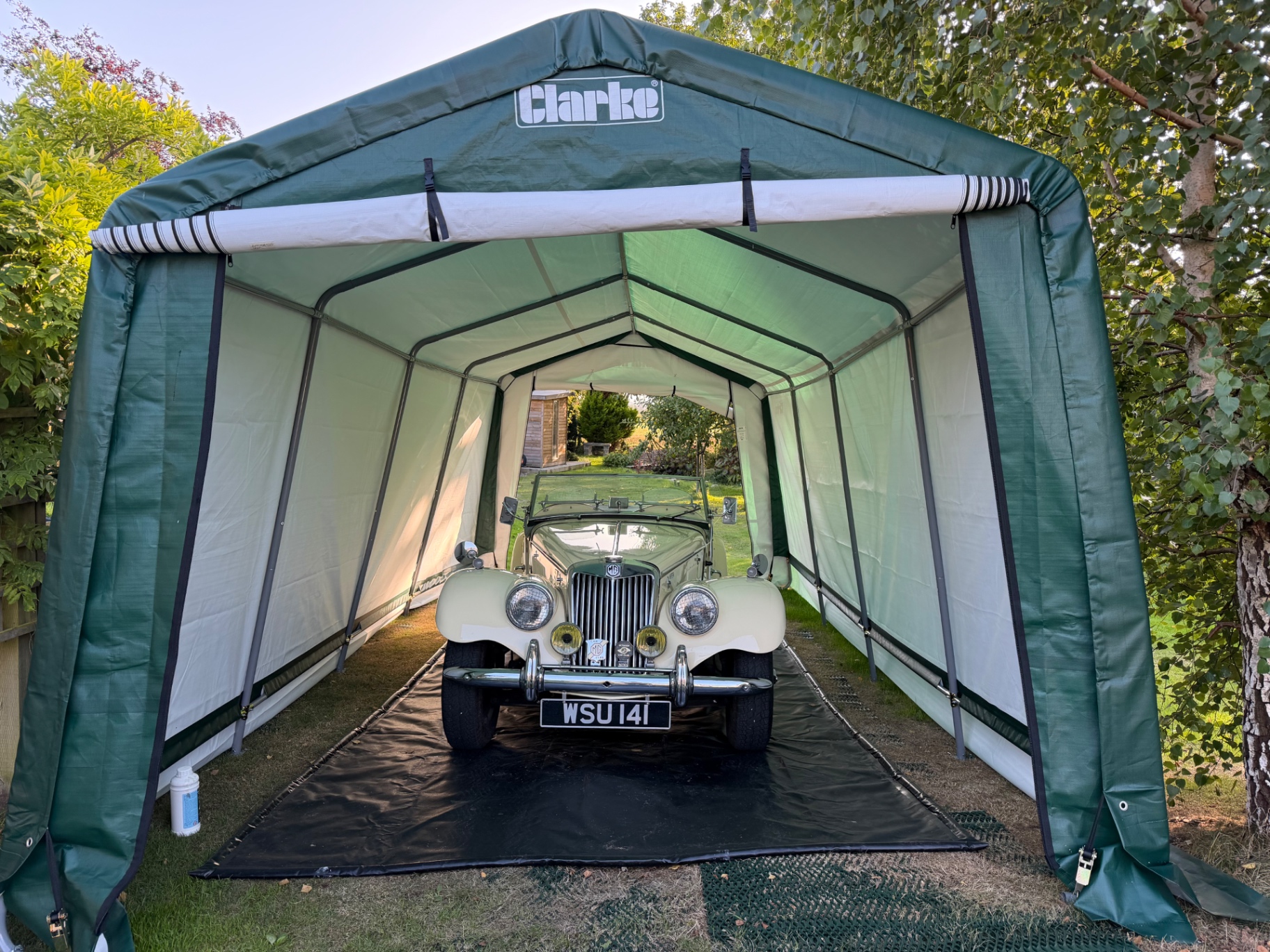
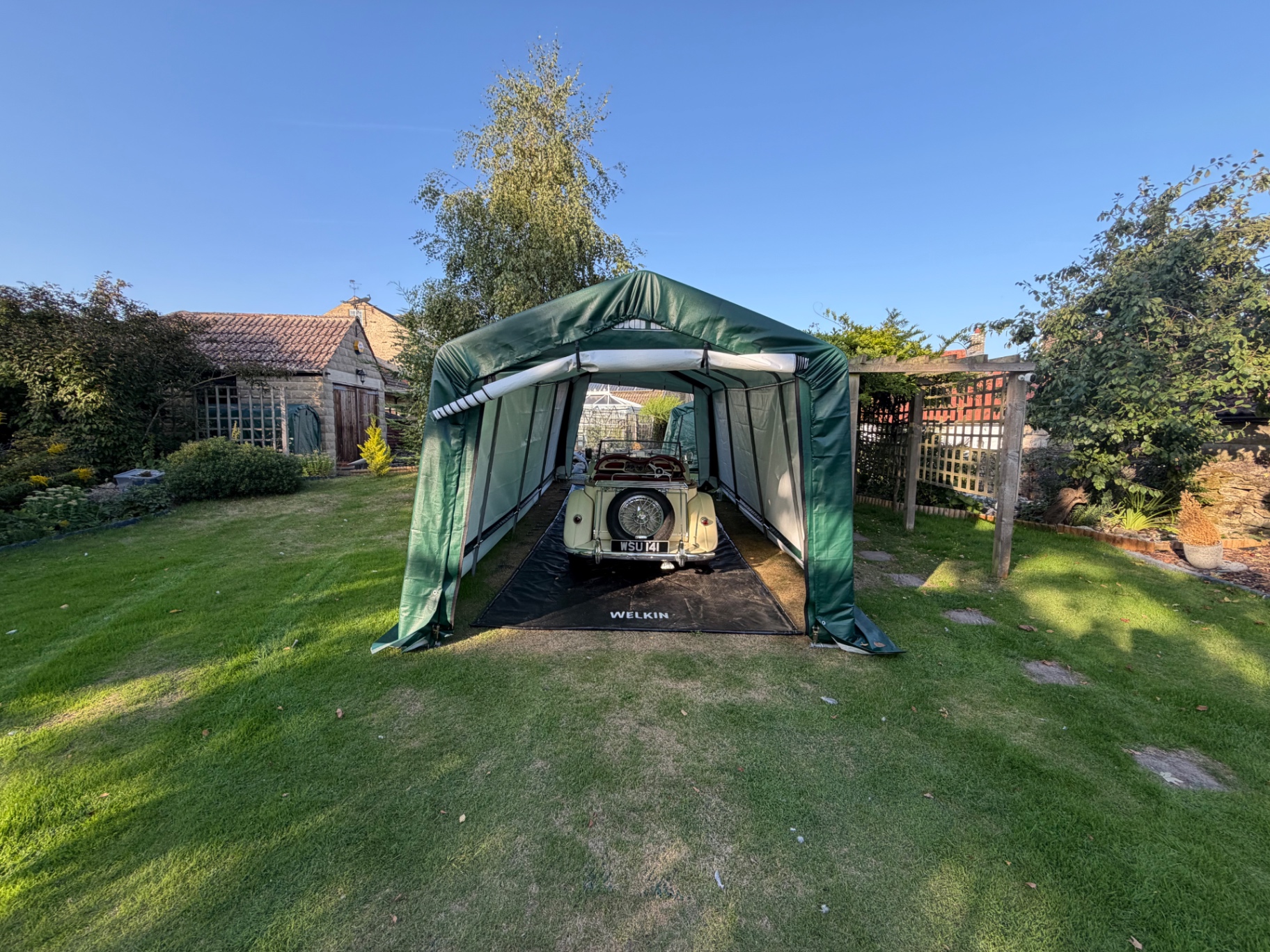
A portable shelter such as the Clarke tent shown above is a practical middle way for owners without a permanent garage: it keeps rain and frost off the bodywork while still allowing enough airflow to avoid the stagnant, damp atmosphere that causes corrosion. The important thing is to put the car away clean and dry, and to site the shelter on level, well-drained ground.
Where to store it: garage, cover or Carcoon
A dry, ventilated garage is the ideal, but with a caveat: an unheated garage still pairs cold metal with still, humid air, which can bloom surface rust on chrome. On a bare concrete floor, a board or vapour barrier under each tyre stops damp wicking up, and a little airflow or a low dehumidifier helps.
An active air-flow bubble, a Carcoon and similar systems, is excellent at damp control precisely because its fans keep air constantly moving, so condensation never settles against the metal. It needs mains power with the fans left running, the car must go in clean and bone dry, and you should choose the indoor or outdoor-rated type to match where it lives. For brightwork in particular, that constant dry airflow can be kinder than a cold static garage.
A cover on a car left outdoors is the thing to avoid. However good the cover, an outdoor car under a static cover in damp weather condenses moisture and holds it against the metal, the classic cause of surface-rust bloom on chrome. If a cover is genuinely your only option, use a breathable one (never plastic-backed) and only ever put it on a completely dry car.
The golden rule beneath all of it: dry before you seal, and moving air beats still air. A sealed space full of damp does more harm than an open, airy one.
Preparing the car: the pre-storage checklist
An hour before it goes to bed is worth a day in spring.
- 01
Clean and protect
Wash and dry the whole car, road dirt holds moisture, then wax the paint and the brightwork. A layer of wax is cheap insulation against a winter's damp.
- 02
Fresh oil
Change the engine oil and filter before lay-up, not after. Used oil is mildly acidic and full of combustion by-products; left sitting on bearings and cam for months it does slow harm. Run the engine to full temperature first, then change it warm.
- 03
Coolant and antifreeze
Make sure the cooling system has antifreeze at the correct strength, it guards against a cracked block in a hard frost and carries a corrosion inhibitor. A T-type left with plain water in an unheated space over winter is asking for expensive trouble.
- 04
Fuel and ethanol
Modern UK pump petrol (E10) contains up to 10% ethanol, which absorbs moisture, attacks the older rubber and fibre in a T-type's fuel system, and goes stale over months. For storage, use E5 “super” unleaded, fill the tank almost full so there is little air space to condense, and add a fuel stabiliser. Some owners instead drain the carburettor float chambers to stop fuel gumming the jets, either approach is sound.
- 05
Battery
Disconnect it, or better, leave it on a smart conditioner/maintainer (a CTEK, Optimate or similar) that keeps it charged without overcharging. A flat battery left all winter is usually a dead one by spring.
- 06
Tyres
Inflate a little above normal to reduce flat-spotting, and if you can, roll the car a few inches every few weeks so the tyres don't stand on one point all winter.
- 07
Brakes off
Leave the handbrake OFF and chock the wheels instead. Left on for months, brake shoes can stick to the drums and cables can seize; chocks hold the car while the brakes stay free.
- 08
Damp inside
If the car is under cover indoors, leave a window very slightly ajar so the cabin can breathe, and put a couple of moisture-absorber bags inside. Feed the leather and the hood so they don't dry out.
- 09
Keep the mice out
Stored cars are a magnet for rodents, which nest in warm airboxes and chew wiring and trim. Leave nothing edible in or near the car, and consider a deterrent; if you block the exhaust or intake against them, leave yourself a clear reminder to remove it before starting.
Mice, rats and a stored car
A car that stands in a garage from October to March is, from a mouse's point of view, a warm dry nest box with its own food store and bedding. The engine bay holds heat for hours after the last run, the air filter box and the silencer are sheltered tubes, and the seat foam, carpet underfelt and hood lining are nesting material. House mice can get through a gap of 5 to 6 mm, about the diameter of a pencil, so an ordinary up-and-over door with daylight under it is no barrier at all.
The damage they do
The expensive item is the wiring loom. Rodents' front teeth grow continuously and they gnaw to wear them down, and wiring insulation, fuel hose, rubber trunking and sound-deadening felt are all chewed. A loom that has been chewed in several places is a rewire, and a chewed fuel hose on a petrol car is a fire risk. Nests in the air filter box and the exhaust tailpipe are found when the car will not start or runs badly in spring. Carpets, seats and door trims are shredded for bedding, and the smell of a mouse that has died in the heater box or under the carpet takes a long time to clear.
A T-Type is an open car with a fabric hood, side screens and a tonneau, and none of them seals against a mouse. The air cleaner or cleaners on the SU carburettors (one shared box on a TD, one per carburettor on a TF), the scuttle and the space under the rear floor are the usual nest sites, and the loom behind the dashboard is the thing a chewed wire costs most to put right. If the car lives under a cover or in an inflatable shelter, a mouse that gets inside the cover is in the warmest place in the garage, so check under it, not just round it.
Two further points worth knowing. Insurers commonly treat rodent damage as damage that happened gradually, which most motor policies exclude, and a UK Financial Ombudsman decision in 2018 did not uphold a complaint against Aviva, which had refused a claim for chewed engine wiring on exactly those grounds. And the story that modern soy-based wiring insulation attracts rodents is unproven; a US court dismissed a class action against Toyota on the point in 2018 because the owners could not show a defect, and Toyota said it knew of no scientific evidence that rodents are attracted to soy-based insulation. There is no reason to think an old loom is any safer than a new one.
What works
Keep them out of the building first. Seal gaps round pipes, cables and door frames with wire wool packed in and covered with filler or mortar, since mice will chew through foam, plastic and wood but not steel wool. Fit a brush strip or a rubber seal to the bottom of the garage door. Keep the floor clear, keep bird seed, pet food and lawn seed in metal or heavy plastic bins with lids, and do not leave bags of anything edible, including grass seed and bulbs, in the same building as the car.
Then make the car itself unwelcoming. Clean out every crumb before lay-up and leave nothing edible inside. Close the windows fully, or if you leave them cracked for ventilation, cover the gap with fine mesh. Bung the exhaust tailpipe and the air intake with a rag or a rubber bung, and hang a large label on the steering wheel saying so, because a forgotten exhaust bung is a classic spring mistake. Leave the bonnet up if the garage is secure: a cold, open engine bay is less attractive than a warm enclosed one, and you can see what is happening.
Set traps and check them. Conventional snap traps baited with peanut butter or chocolate, set against walls where mice run, are cheap and reliable, and a trap that has caught nothing in a month is useful information in itself. Check them weekly along with the car, and look for the signs: droppings the size of a grain of rice, shredded paper or felt, gnaw marks, and a musky smell. A fortnightly walk round the car with a torch, looking in the air filter box, under the scuttle, in the boot and under the seats, catches a problem while it is still one nest and not a rewire.
What is unproven
Ultrasonic repellers are widely sold and the evidence is mixed: one published single-house trial found fewer mice caught while a unit was running, but the general view of research bodies and pest control advisers is that rodents get used to the sound within days and that the devices are not a substitute for proofing and traps. Peppermint oil, dryer sheets, mothballs and cat hair are all repeated on forums; none has good evidence behind it, and naphthalene mothballs have not been legal to sell in the UK since 2008. By all means use them, but not instead of the measures above.
Poison
Rodenticide is a last resort. It is sold to the public only in small packs for use in and around buildings, it must be kept where pets and children cannot reach it, and a poisoned mouse often dies somewhere in the car, which is the smell problem again. If you have an established infestation rather than a single visitor, a professional pest controller is a better call than more bait.
Glue traps are banned for the public across Great Britain: in Wales since 17 October 2023, in England since 31 July 2024, where only licensed professional pest controllers may use them, and in Scotland since 1 July 2026, where sale and possession are banned as well. In England and Wales they are still on sale, which is not the same as being legal to use.
In spring
Before the first start, take the air filter off and look inside the box, lift the carpets and check under the scuttle and round the fuse box and loom for chewed insulation and nesting. Remove the bungs. If you find chewed wiring, trace it fully before switching on; a short to earth is cheaper to find with a meter than with a fuse.
Short version
Seal the garage with steel wool and a door strip, store nothing edible in it, bung the exhaust and intake and label the car, set snap traps and check them and the car every week or two, and treat ultrasonic devices and peppermint as extras rather than a plan.
Don't just idle it now and then
The instinct to fire it up for five minutes once a month does more harm than good: a brief cold idle never reaches the temperature needed to drive off the moisture and fuel that condense in the oil and exhaust, so it leaves the engine wetter and more acidic than before. Far better to leave it properly asleep, or, if you want to run it, get it fully up to temperature and ideally take it for a proper drive. On a dry winter's day a real run is the best thing you can do for it; a cold idle on the drive is the worst.
Waking it in spring
Reverse the process, and don't rush the first start. Check the oil, coolant and brake fluid; look for leaks and any sign of rodents; check the tyre pressures; reconnect and check the battery; and remove anything you put in the exhaust or intake. Then a gentle first run to bring everything back up to temperature. A car put away properly comes back with almost no complaint.
The short version
Dry, waxed and clean; fresh oil, protected coolant, stabilised fuel; battery on a conditioner; tyres up and handbrake off; damp and mice kept out; and stored somewhere the air stays dry and moving, a garage, or an active bubble like a Carcoon, rather than sealed under a cover in the damp. Do that, and winter becomes a pause rather than a problem.
Questions owners ask
- How do I keep mice out of my classic car in the garage?
- Seal the building (wire wool in gaps, a brush strip on the door), keep nothing edible in it, clean the car out, bung the exhaust and air intake and label the car, and set snap traps that you check weekly along with the car itself.
- Do ultrasonic mouse repellers work?
- The evidence is mixed and research bodies say rodents get used to the sound within days. Treat one as an extra, not as a substitute for sealing the building and setting traps.
- Does classic car insurance cover mouse damage?
- Often not. Most motor policies exclude damage that happens gradually, and a Financial Ombudsman decision in 2018 did not uphold a complaint about a refusal on those grounds. Check your policy wording.
Read next
This guide is a general introduction and is not a substitute for the official Workshop Manual for your car.